IRCTC Debunks Viral ‘Math Exam’ CAPTCHA Screenshot
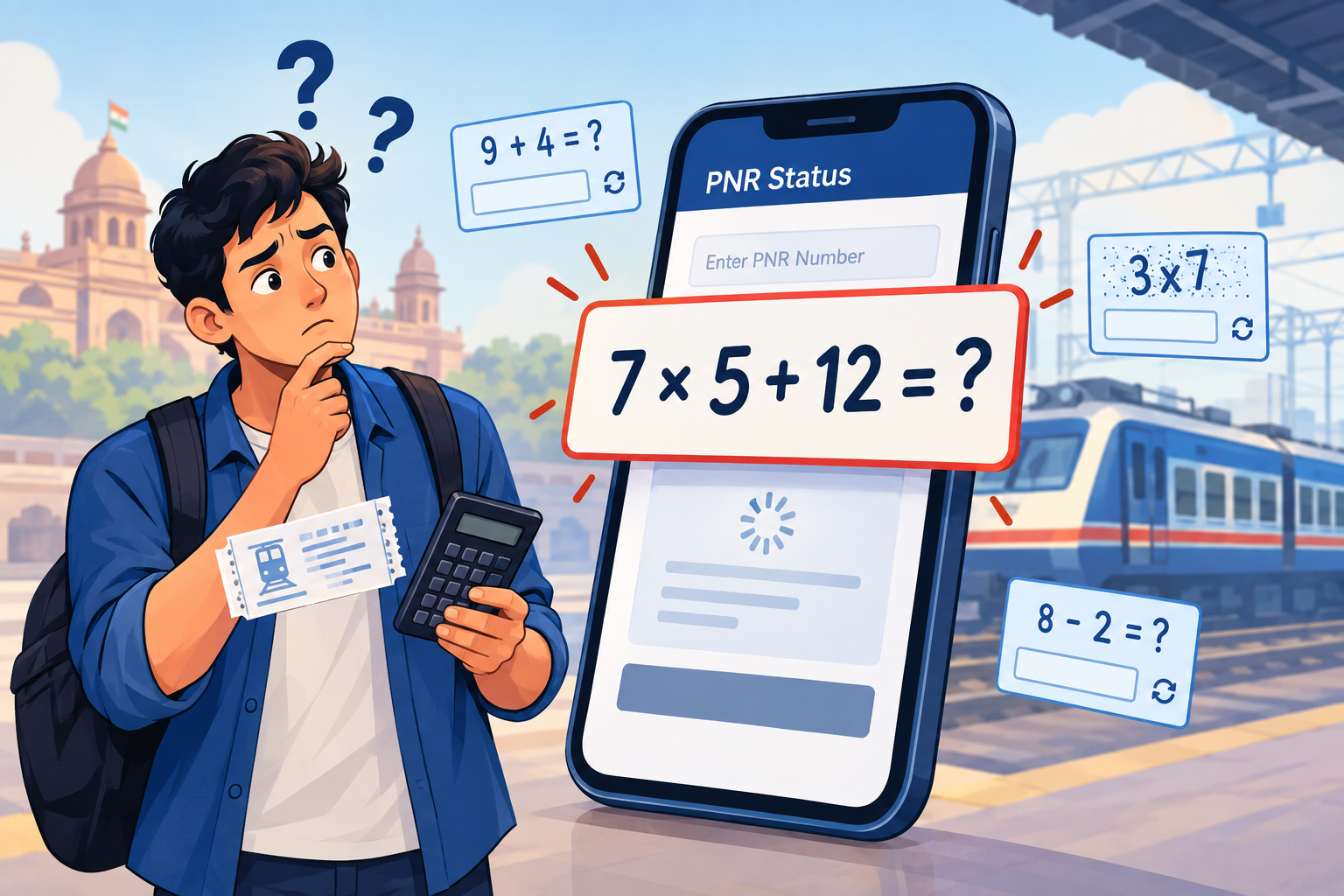
A screenshot that appeared to turn a routine PNR status check into a daunting mathematics test sparked a wave of jokes and disbelief across social media. The image purportedly showed an IRCTC page asking a passenger to solve a multi-step equation before viewing train reservation details.

The supposed CAPTCHA displayed the expression “(9876 × 543 − 2468) ÷ 4 = ?” — a sharp departure from the simple verification questions passengers usually encounter. After the image began circulating on September 20, users joked that checking a railway ticket now required preparation for a competitive examination.
However, the viral moment was not what it initially appeared to be. IRCTC issued a clarification saying that the complicated CAPTCHA shown in the image does not match the system currently implemented on its website.
IRCTC says the viral image is not authentic
According to IRCTC, its active mathematical CAPTCHA uses straightforward addition or subtraction involving two-digit numbers. The corporation said the widely shared screenshot appeared to have been fabricated, manipulated or generated using artificial intelligence rather than captured from the genuine website.
That clarification means passengers are not expected to solve lengthy multiplication and division problems to check their PNR status. IRCTC advised users to verify the experience directly through the official railway platform instead of treating circulating screenshots as proof of a website change.
The response arrived after several days of online discussion. While many users treated the image as an opportunity for humour, others had questioned its authenticity from the beginning. They noted that railway CAPTCHA prompts were generally much simpler and argued that the equation looked unusually elaborate for a basic human-verification step.
Social media turns CAPTCHA into a meme
Before the clarification, the screenshot generated jokes about passengers needing calculators alongside their ticket details. Some users compared the problem to questions from engineering entrance examinations, while others joked that Indian Railways was providing free mathematics coaching with every PNR enquiry.
The humour worked because CAPTCHA complaints are already familiar to many online railway users. Passengers often have to complete verification checks during login, booking or status-related tasks, making the exaggerated equation instantly relatable even to people who doubted that it was genuine.
The original post was framed as a passenger simply trying to check a PNR status and being confronted with an unexpected challenge. That premise helped the image spread rapidly, demonstrating how a plausible interface and a humorous caption can push an unverified screenshot into wider online conversation.
Why railway platforms use CAPTCHA checks
CAPTCHAs are intended to distinguish human visitors from automated programs. On a high-demand reservation platform, they can help limit the use of scripts and bulk-booking tools that attempt to complete transactions faster than ordinary passengers.
Indian Railways has previously described CAPTCHA and related timing checks as safeguards against automated software being used to corner tickets. Such protections are particularly relevant during periods of intense demand, when large numbers of passengers may be competing for limited seats.
At the same time, verification tools must remain easy enough for genuine users to complete. If a CAPTCHA is confusing, slow or inaccessible, it can become another obstacle for passengers who are already navigating a time-sensitive booking process. That tension between security and convenience explains why even a fabricated example could generate such a strong reaction.
A reminder to verify viral screenshots
The episode also highlights the growing difficulty of judging screenshots at face value. Website interfaces can be altered with basic editing software, browser tools or generative AI, while familiar branding can make a false image appear convincing.
In this case, a comic post evolved into apparent evidence of a major change to a widely used public service. IRCTC’s clarification has established that the advanced equation was not part of its current CAPTCHA functionality.
For passengers, the practical takeaway is simple: routine PNR checks have not been converted into advanced mathematics tests. If an unusual railway screenshot appears online, checking the official platform remains more reliable than relying on a viral image — no calculator required.