Russia Backs India’s Permanent UNSC Bid, but Reform Hurdles Remain
Russian Foreign Minister Sergey Lavrov has reaffirmed Moscow’s support for India’s candidature for permanent membership of the United Nations Security Council, placing the issue among Russia’s priorities for reform of the world body.

Addressing the general debate of the 81st session of the UN General Assembly in New York on September 26, Lavrov supported permanent seats for India and Brazil as part of a wider expansion intended to increase representation for Asia, Africa and Latin America. He also argued against allocating additional permanent seats to Western countries, specifically opposing the inclusion of Germany and Japan.
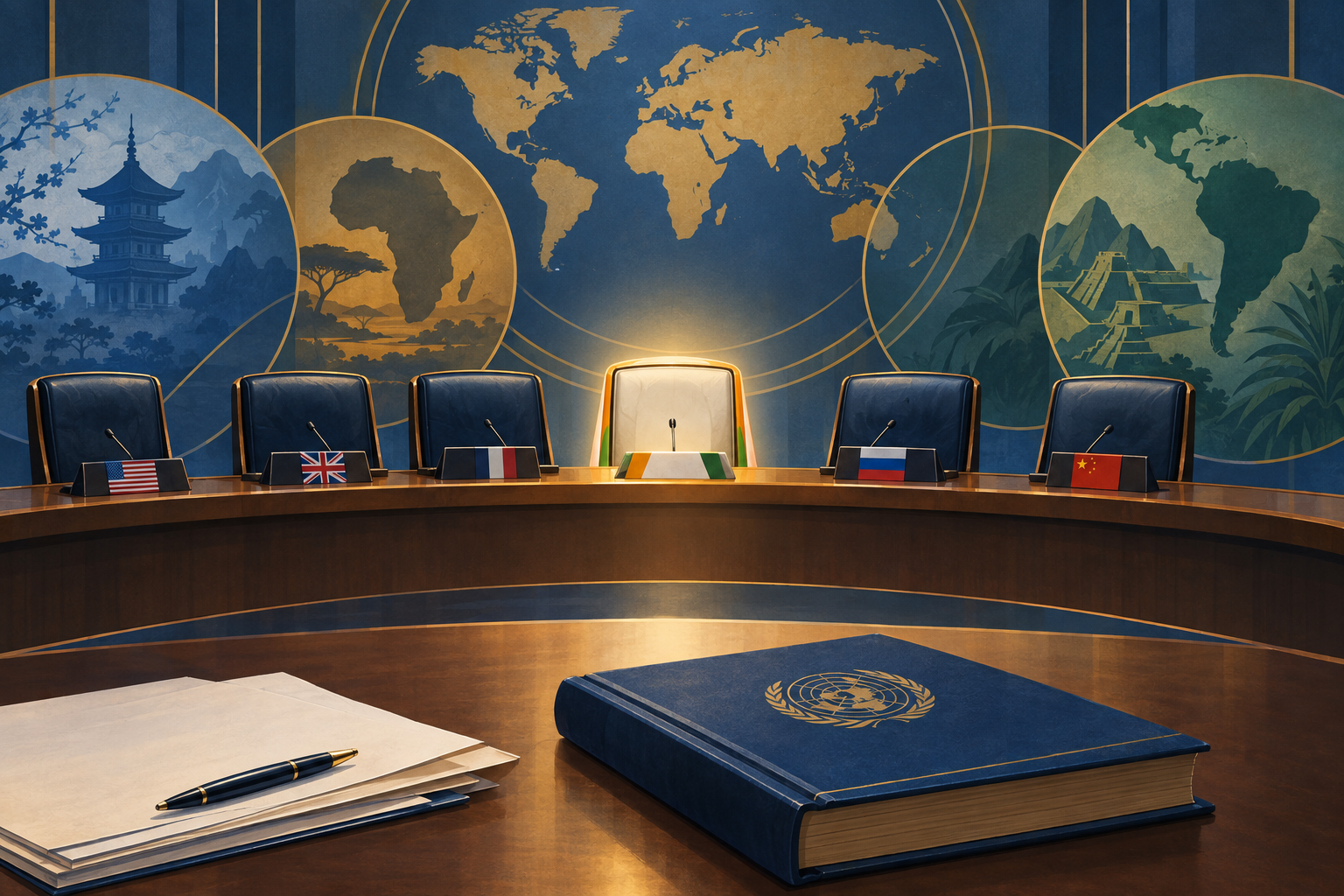
The statement is diplomatically significant for India because Russia is one of the Security Council’s five permanent members, alongside China, France, the United Kingdom and the United States. Each permanent member possesses veto power over substantive Council resolutions and would have to accept any Charter amendment expanding permanent membership.
What Russia’s support means for India
Moscow’s endorsement strengthens India’s argument that the Council’s structure no longer reflects contemporary political, economic and demographic realities. India is the world’s most populous country, a major economy, a nuclear-armed state and a longstanding contributor to UN peacekeeping operations. New Delhi has maintained that these credentials justify a permanent role in decisions concerning international peace and security.
Russia’s position also reinforces its broader diplomatic partnership with India. By supporting New Delhi and Brazil, Moscow can present itself as an advocate for greater influence for the Global South while resisting reforms that would expand the representation of Western-aligned powers.
That distinction matters. Russia’s preferred reform model is not necessarily identical to India’s wider negotiating position. India works with Brazil, Germany and Japan through the Group of Four, whose members support one another’s bids for permanent seats. Lavrov’s opposition to Germany and Japan illustrates how countries can endorse India individually while disagreeing with the broader package India has promoted.
Why Security Council reform remains difficult
There is broad agreement among UN members that the Council should become more representative, but there is no consensus on what an expanded body should look like. Governments disagree over how many seats should be created, which regions should receive them, whether new members should be permanent and whether they should have veto rights.
African states have demanded stronger representation, including permanent seats for a continent that currently has none. The Group of Four supports new permanent memberships for India, Brazil, Germany and Japan, along with greater African representation. Another coalition, commonly known as Uniting for Consensus, opposes creating additional permanent members and instead favours more elected or longer-term seats.
Regional rivalries add another obstacle. States may support reform in principle while resisting the elevation of a neighbouring country or strategic competitor. The veto question is equally contentious: extending it could make Council decision-making more difficult, while denying it to new permanent members could create a second tier of permanent membership.
Years of intergovernmental negotiations in the General Assembly have therefore produced repeated discussions and statements of support without agreement on a negotiating text capable of commanding the required majority.
No change to the UN Charter
Lavrov’s remarks are a statement of Russian policy, not a decision by the United Nations. India has not been added to the Security Council as a permanent member, and no new permanent seat was created during the General Assembly address.
The Council continues to have 15 members: five permanent members and 10 non-permanent members elected by the General Assembly for two-year terms. India’s separate candidature for an elected Council term in 2028–29 should not be confused with its long-term campaign for permanent membership.
Changing the permanent membership structure would require an amendment to the UN Charter. Such an amendment must first be adopted by two-thirds of the General Assembly and then ratified by two-thirds of all UN member states, including every existing permanent Security Council member. In practical terms, each of the five permanent members can prevent the reform by withholding ratification.
Russia’s endorsement consequently gives India valuable political backing from a country whose consent would be essential. However, it neither guarantees agreement among the other permanent members nor resolves divisions across the wider UN membership. For India, the statement represents diplomatic momentum rather than an immediate institutional breakthrough.