
Sand Snake Sighting Reconnects Kutch With a 150-Year-Old Record
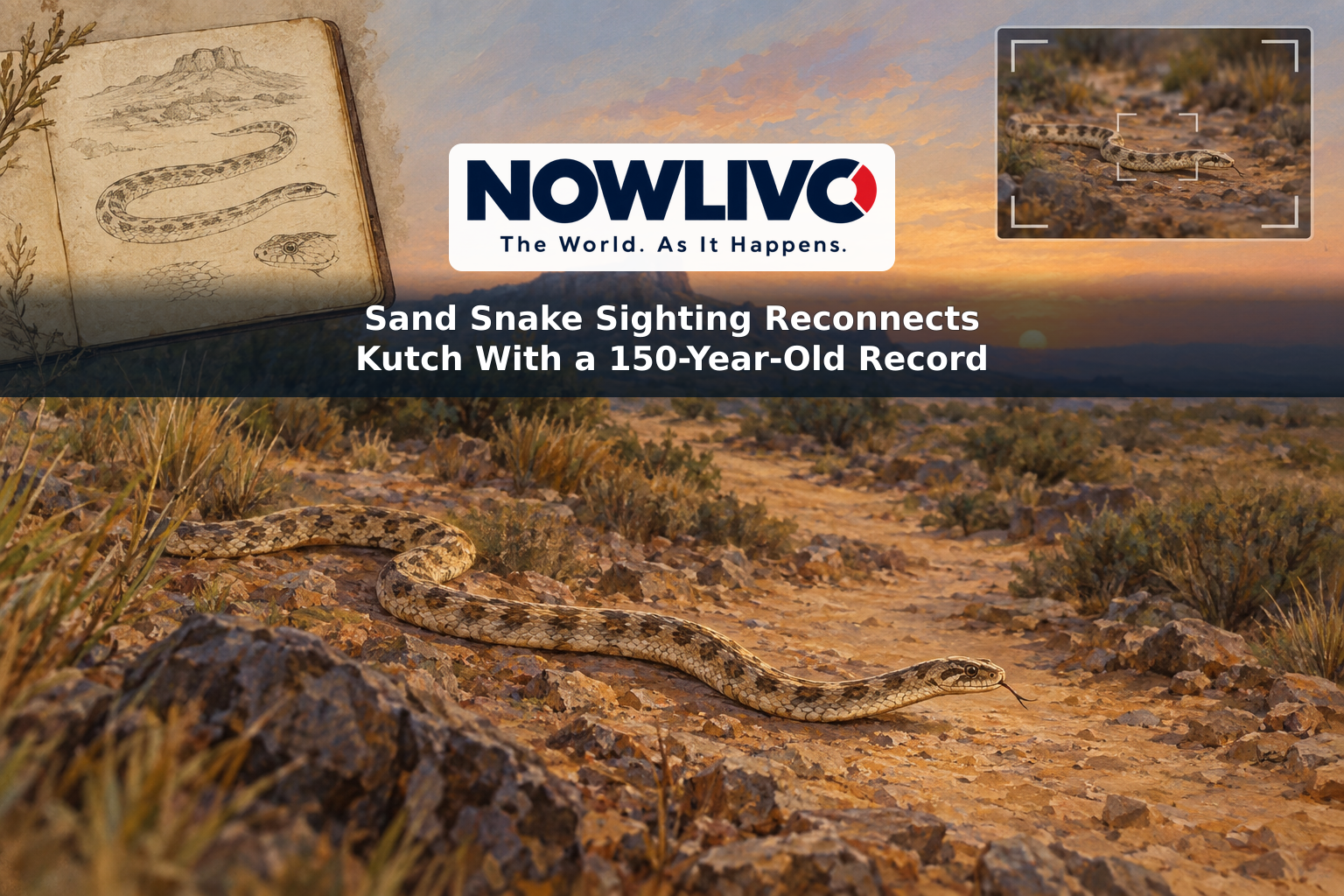
A slender snake crossing a road near Kala Dungar has given wildlife observers in Gujarat’s Kutch district a link to a record more than 150 years old. Forest officer Jayesh Dumadiya photographed and filmed the animal during a patrol on September 6, 2026. Experts who examined the images identified it as an Afro-Asian sand snake, Psammophis schokari.
The sighting drew wider attention in reports published on September 30. That was the report date, not the day the snake was seen. The distinction matters because the finding rests on what Dumadiya and his team documented at the roadside earlier in the month.
An unexpected second snake
Dumadiya, a range forest officer in the Gujarat Forest Department’s Bhuj North Range, was returning from patrol with colleagues at about 7:30 p.m. when they stopped for another reptile: a black-headed royal snake near their vehicle. While the team dealt with that encounter, a second snake appeared on the road.
The newcomer was unfamiliar to Dumadiya. Rather than relying on a brief impression in fading light, he took photographs and video and shared the material with specialists and snake rescuers for identification. Their assessment pointed to the Afro-Asian sand snake, a swift, slender species associated with arid landscapes. The photographed animal was not the black-headed royal snake that had first prompted the stop.
Photographs and video make this encounter more useful than an unverified account. They allow other observers to examine visible features and preserve a record of what the patrol saw. Forest officials have said they hope to document the finding further for scientific publication. A field identification and a published scientific account are related steps, but they are not the same thing.
Why the 1872 record matters
The historical connection leads to naturalist Ferdinand Stoliczka, who surveyed Kutch in 1871 and 1872 and recorded its reptiles. According to Dheeraj Mittal, the Conservator of Forests for Kutch Circle, Stoliczka’s work provides the district’s earlier documented record of the Afro-Asian sand snake. That puts roughly 154 years between the 1872 account and this year’s photographed encounter.
The gap should not be mistaken for proof that the species vanished from Kutch and then returned. Dumadiya said there had been a few possible intervening sightings, but they were not conclusively confirmed. Nor does the gap mean the snake disappeared from India: the species is known from arid areas of Gujarat and Rajasthan and has a much wider range beyond the country.
What makes this observation notable is its local value. It supplies contemporary visual documentation from Kutch that can be compared with the older record. Mittal described that verification as significant and said he intends to pursue a formal account. The sighting does not, by itself, show whether the snake is common or scarce in the district, how widely it occurs there, or whether its numbers have changed.
A closer look at dry-country wildlife
Kala Dungar lies in a hilly, semi-arid part of Kutch. Open, dry country can look sparse to an observer passing through, but a brief roadside encounter illustrates why appearance is a poor measure of its wildlife. Reptiles can be difficult to notice, and an animal that is present may still go undocumented for years when observers are not in the right place at the right time.
For Dumadiya, the find challenges the idea that Kutch’s arid terrain has little biological richness. Mittal likewise sees the observation as a reason to pay closer attention to parts of the district that remain insufficiently explored. Their point is not that one snake proves a healthy population. It is that an old record, newly supported by images, raises better questions for field study.
Further surveys could establish where the Afro-Asian sand snake occurs locally, which habitats it uses and whether additional individuals can be reliably documented. For now, the strongest conclusion is a precise one: a forest patrol recorded the species near Kala Dungar on September 6, giving Kutch a fresh observation to set beside its 19th-century natural history.