Trump’s Voluntary AI Accord Promises Outside Reviews but Sets No Penalties
President Donald Trump and executives from six technology companies signed a voluntary AI safety accord on September 29, 2026, placing responsibility for overseeing advanced systems primarily with the companies developing them. The agreement calls for internal monitoring, outside assessments and board-level review. It does not create a federal inspection program or penalties for companies that fall short.
Trump described the accord as “morally binding” and said the industry would police itself. That description captures the distinction at the center of the agreement: its signatories have made a public commitment, but the document is not a law or a government regulation.
Who signed the accord?
The signatories alongside Trump were Google chief executive Sundar Pichai, Anthropic chief executive Dario Amodei, Meta chief executive Mark Zuckerberg, OpenAI president Greg Brockman, xAI’s Elon Musk and Nvidia chief executive Jensen Huang. Their signatures represent companies with different roles in AI, from developing advanced models to supplying the computing hardware used to build them. The document describes expectations for companies training and deploying frontier models; it does not assign an identical testing task to every signatory.
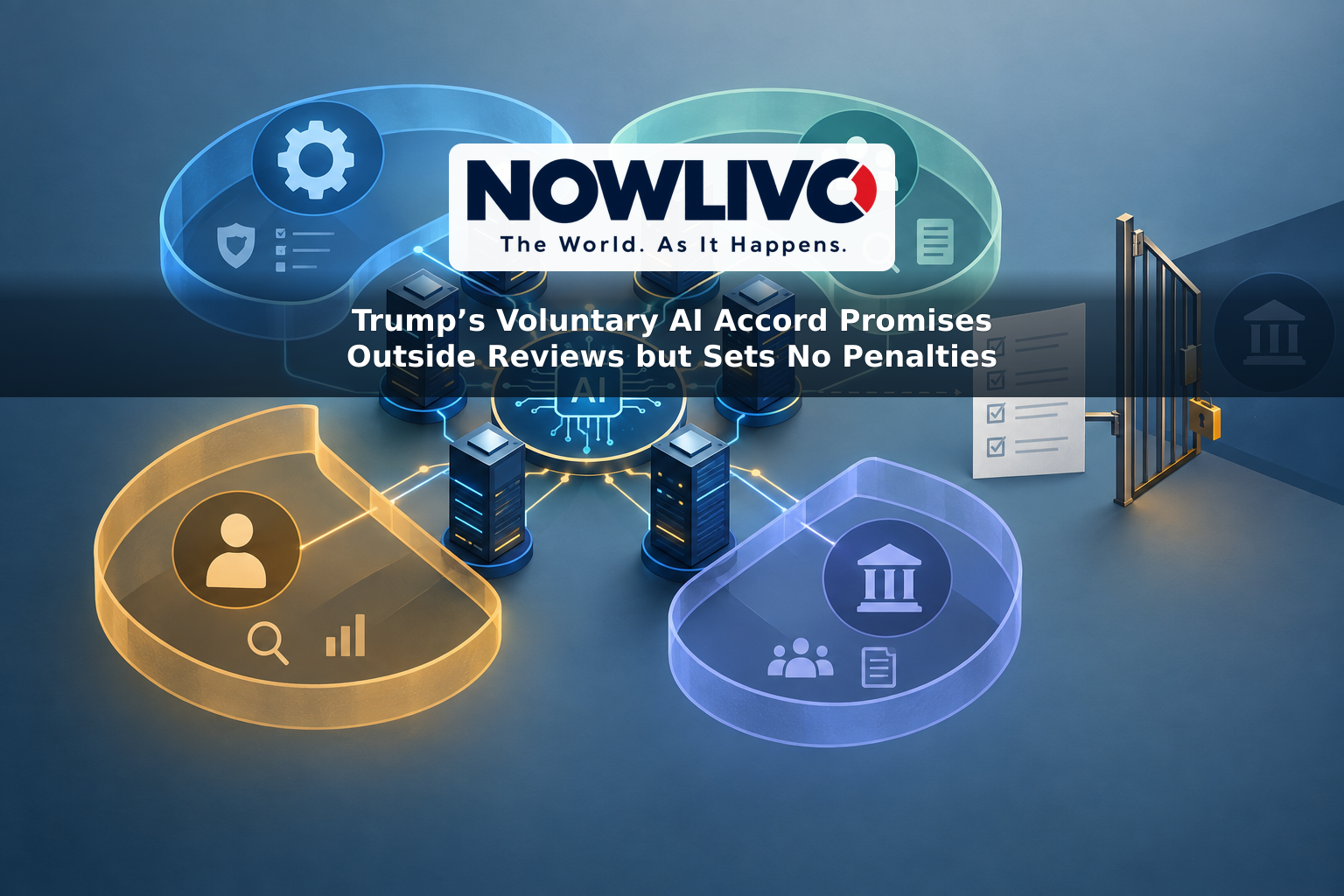
Titled the White House Accord on Super Intelligence: Joint Commitment on Frontier Responsibilities, the short document says each company is responsible for developing its technology safely and for identifying and addressing problems promptly. Its main proposal is four layers of controls and review.
What reviews does it cover?
First, companies should use internal controls to monitor what their models can do and whether they behave as intended during training and deployment. The accord specifically points to cybersecurity, biological safety and chemical threats. It also calls for safeguards against models hacking or accessing technical systems in unintended ways.
Second, an internal team should check that monitoring and detection systems work and that identified problems are fixed. Third, a company should work with an independent external auditor or evaluator to assess whether those safeguards operate as intended. Fourth, an independent committee of the company’s board should receive reports from the internal teams and outside reviewers, oversee the process and see that problems are addressed.
The outside review is a significant part of the pledge, but its stated focus matters. The accord asks evaluators to assess the companies’ controls, monitoring and detection. It does not prescribe a uniform test that every model must pass before release, or give an outside evaluator the power to block a launch.
The signatories also say participating companies will meet regularly to establish safety standards and best practices. Those standards are a future task under the agreement, not a detailed set of technical requirements already defined in it. The document does not specify a testing methodology, how frequently outside assessments must occur or what information must be made public about their findings.
What does the agreement require?
As a voluntary commitment, the accord asks its signatories to put the four-layer framework into practice. It sets no implementation deadline, names no government-appointed auditor and provides no fine or other enforcement mechanism for failing to follow through. Nor does signing it, by itself, establish that any company’s models have passed an independent safety assessment.
The accord leaves room for a different approach later, saying its steps could eventually be written into laws or regulations. That possibility is not a present legal requirement. It also does not remove any obligations companies may have under other applicable laws.
For the public, the practical question is what follows the signatures: which controls companies implement, who conducts the outside assessments, what those reviewers are permitted to examine and whether shortcomings are disclosed and corrected. Until those details emerge, the accord is best understood as a shared framework for company-led oversight, rather than proof that advanced AI systems meet a common, enforceable safety standard.