
UPI merchant charges could start October 15 after Supreme Court declines stay
Some businesses accepting Unified Payments Interface (UPI) payments may face a processing charge from October 15, 2026, after the Supreme Court declined on September 28 to put the government’s new framework on hold. The decision does not mean every UPI payment will cost money, nor does it settle whether the framework is legally valid.

The proposed merchant discount rate, or MDR, applies to specified payments made to merchants rather than transfers between individuals. Under the general rate, an eligible merchant payment above ₹2,000 would attract a charge of 0.4%. The charge is designed to be shared within the payment system, including among banks and payment providers. The government says it is not a tax and is not collected by the government or the National Payments Corporation of India.
What changes for merchants?
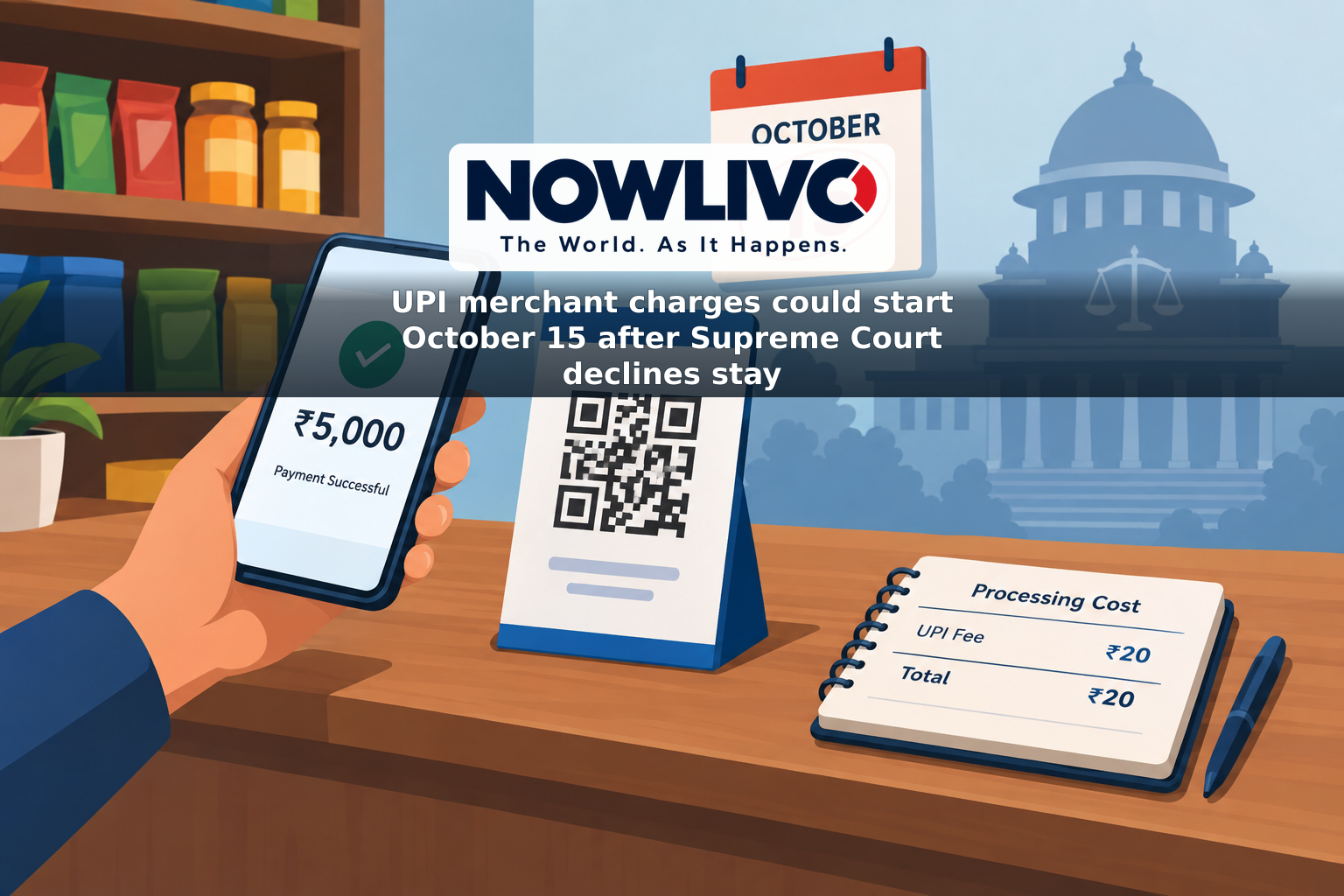
For businesses covered by the general rate, accepting a qualifying UPI payment will carry a processing cost. At 0.4%, a ₹5,000 payment would produce an MDR of ₹20; a ₹10,000 payment would produce a charge of ₹40. The framework caps the charge at ₹300 for transactions of ₹75,000 or more. That is a cost associated with receiving the payment, not an additional amount the customer is supposed to pay at checkout.
The ₹2,000 threshold applies to the value of a merchant transaction. A payment of ₹2,000 remains outside the general MDR, while a qualifying payment above that amount falls within it. Merchants will need to distinguish between the standard rate and the separate treatment provided for certain types of payment.
Small merchants receiving up to ₹1 lakh a month through UPI QR codes under the framework’s small-merchant category will continue to have zero MDR on those transactions, even when an individual payment exceeds ₹2,000. For payments above ₹2,000 in specified sectors—including railways, telecommunications, insurance, fuel and agricultural inputs—the framework instead provides a flat ₹5 charge. Payments relating to capital markets have a 0.02% rate, capped at ₹300.
Will customers pay more to use UPI?
The government’s framework does not impose an MDR on customers making UPI payments. Person-to-person transfers remain free regardless of amount, and merchant payments of up to ₹2,000 remain outside the MDR. The Finance Ministry says banks have been advised to ensure merchants do not pass the processing charge on to customers. UPI app providers are also prohibited under the framework from adding platform fees or hidden charges.
That distinction matters at the counter. A customer making a qualifying ₹5,000 payment should not see an automatic ₹20 UPI fee added by the payment app. A merchant may nevertheless be concerned about how to absorb a new operating cost, particularly on low-margin sales. Whether businesses change their prices over time is a separate question from whether the framework authorises a direct MDR charge to the customer.
The Finance Ministry estimates that about 96% of merchant transactions will remain unaffected, either because they are below the threshold or because they qualify for the small-merchant exemption. That estimate concerns the number of transactions, not a promise that every business will see the same effect.
What did the Supreme Court decide?
At its September 28 hearing, the Supreme Court sought responses from the Union government, the Reserve Bank of India, the National Payments Corporation of India and others to a petition challenging the framework. The court declined the petitioner’s request for an interim stay, leaving the planned rollout in place for now. It asked the government to explain the basis for the charge and the arrangement behind it.
The petitioner questions the legal authority and process used to introduce the MDR, as well as how its thresholds and rates were determined. The government maintains that revenue from specified merchant transactions is needed to help support UPI payment infrastructure. Those arguments have not been finally decided: refusing to pause a policy while a case proceeds is different from upholding it after a full hearing.
For now, October 15 is the expected start date given to the court by the government. Merchants should plan around the published categories and rates, while customers should know that the proposed MDR is not a general fee on their UPI use. The framework could still be affected by a later court order or a government change.