
US sends roughly 9,000 personnel and third carrier toward Middle East; arrival and mission remain unclear
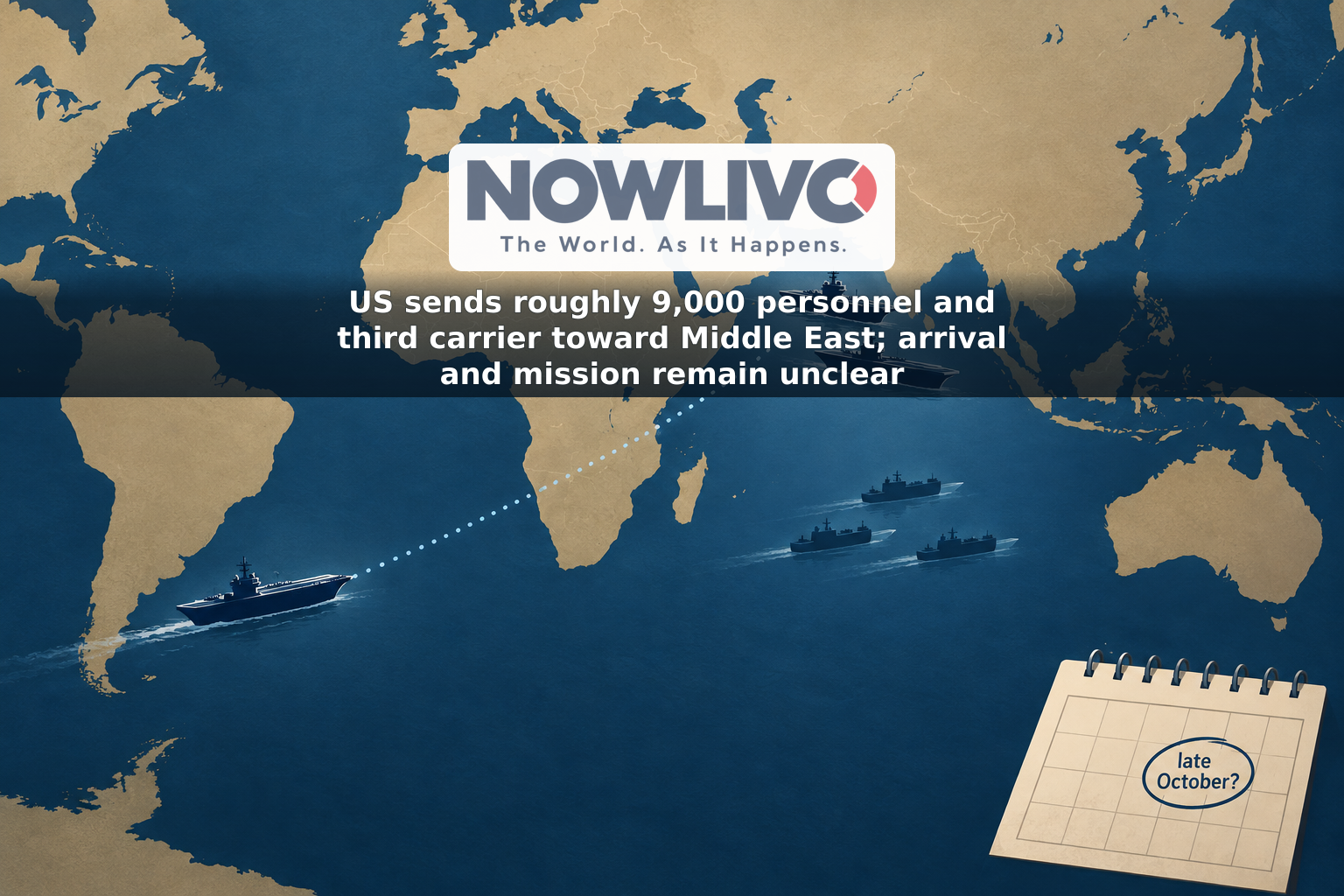
The United States is sending a carrier strike group and amphibious ships carrying roughly 9,000 sailors and Marines toward the Middle East, according to a US official familiar with the movement. The ships could put a third American aircraft carrier in the region by late October, but their arrival date and intended mission have not been publicly confirmed. The deployment does not, by itself, mean that President Donald Trump has decided to order new strikes on Iran.
What is moving
The ships include the USS Theodore Roosevelt carrier strike group and the USS Makin Island amphibious ready group. Together, the groups carry more than 7,000 sailors and about 2,000 Marines, the official said. The Roosevelt group includes the cruiser USS Chosin. The amphibious group includes the landing ships USS John P. Murtha and USS Anchorage.
Those personnel are traveling aboard ships. The reported figure should not be read as an announcement that 9,000 ground troops will enter Iran or be stationed ashore elsewhere in the region. A carrier strike group brings aircraft and accompanying warships; an amphibious ready group carries Marines and equipment that can be used for a range of missions. Their destination does not settle which capabilities commanders intend to use.
The Roosevelt departed San Diego on September 27. Publicly available fleet information placed it in the eastern Pacific on September 28, while two other American carriers—the USS George Washington and USS George H.W. Bush—were operating in the Arabian Sea. The USS Boxer amphibious ready group was also in that region.
When could there be three carriers?
The official said the movements could result in three US aircraft carriers being in the Middle East as early as the end of October. That is a possibility, not a confirmed arrival schedule. Ship movements and operational plans can change, and no firm date for the Roosevelt’s entry into the region has been announced.
It is also unclear how long three carriers would remain there at once. The George Washington was sent from its usual Pacific assignment to relieve the USS Abraham Lincoln, which had spent an extended period at sea. The Roosevelt may, in turn, relieve the George Washington. A temporary overlap during that transition would differ from a decision to sustain three carriers in the region for an extended period.
If the incoming groups join the forces already there, the US naval presence would exceed 20,000 sailors and Marines and include hundreds of aircraft, according to the official’s estimate. That figure describes personnel aboard naval forces, not a newly announced deployment of more than 20,000 people. The Navy also had three carrier strike groups in the Middle East for a period in April.
What is known about the purpose?
The movement comes as Trump leaves open the possibility of intensifying US attacks on Iran. In an interview published October 1, he said increased bombing after the November 3 US midterm elections was possible, but did not give an operational plan or say that he had made a decision. He also said he had rejected a recent Iranian ceasefire proposal as insufficient.
Those remarks provide context for the buildup, not an established explanation for every ship’s deployment. An additional carrier could increase commanders’ options, while an incoming strike group could also replace one already on station. The presence of amphibious ships and Marines likewise does not establish that an amphibious operation is planned. US officials have not publicly specified whether the new forces are meant primarily for reinforcement, rotation, deterrence or a particular military action.
The distinction matters for the timeline as well. Late October is the earliest period the official identified for a possible three-carrier presence; November 3 is the election date Trump mentioned when discussing potential future bombing. Neither date is an announced start date for a new operation. For now, the confirmed development is the movement of the ships and personnel toward the region. How long they remain, whether all three carriers overlap and whether Trump orders further strikes remain open questions.