
Smartphones Power India’s Electronics Exports to $26.66 Billion
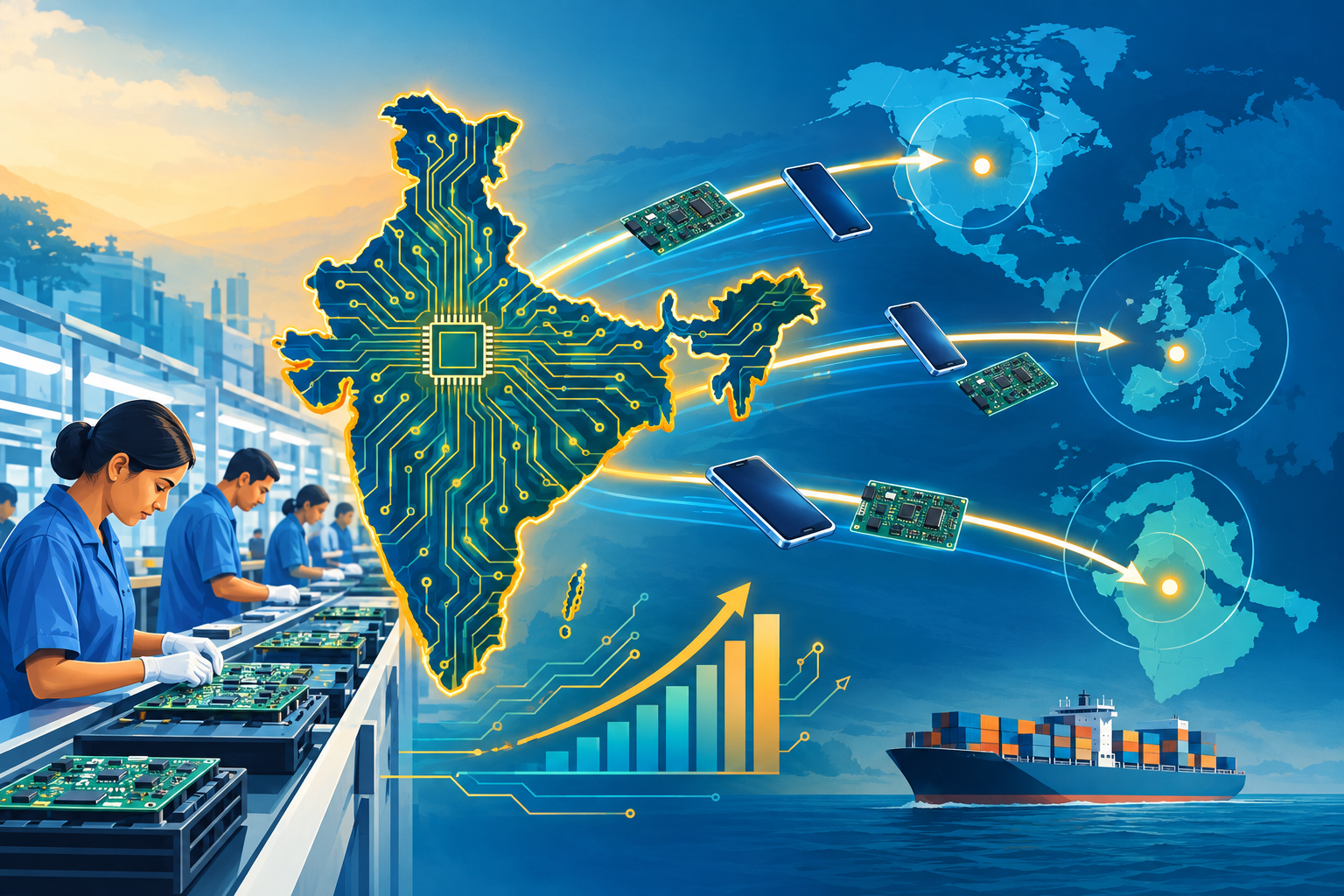
India exported $26.66 billion worth of electronic goods between April and August 2026, the first five months of the 2026-27 financial year. That represented a 39.4% increase from $19.08 billion in the corresponding period a year earlier and made electronics one of the fastest-growing categories in the country’s merchandise export basket.

Smartphones were responsible for most of the increase. Shipments were valued at about $15.96 billion, accounting for nearly 60% of all electronics exports during the period. Other electronics contributed the remaining $10.70 billion, showing that India’s export story is still heavily dependent on handset manufacturing.
Printed circuit boards emerged as the second-largest category, with exports reaching approximately $1.46 billion. Their extraordinary year-on-year growth of more than 2,900% came from a low base, but it is still significant because circuit boards sit deeper in the electronics value chain than final assembly. Continued expansion in components would allow India to retain more value from every device shipped overseas.
How the PLI scheme helped
The export surge is closely connected to the production-linked incentive scheme for large-scale electronics manufacturing, introduced in 2020. Instead of simply subsidising factory construction, the programme tied incentives to incremental production and sales by eligible manufacturers. This encouraged global companies and contract manufacturers to expand Indian capacity while using the country as an export base.
The Apple-led supplier network, Samsung, Foxconn, Tata Electronics and Indian contract manufacturers such as Dixon Technologies have been among the companies expanding production in India. The policy helped manufacturers offset early cost disadvantages while factories increased scale, trained workers and integrated into global supply chains.
Government figures show that the large-scale electronics PLI programme had generated more than 185,000 direct jobs by February 2026. The wider mobile phone ecosystem is estimated to support about 1.2 million direct and indirect jobs, while the broader electronics manufacturing sector supports roughly 2.5 million.
The employment impact is particularly visible in manufacturing centres in Tamil Nadu and Karnataka. Women are estimated to make up close to 70% of the direct mobile manufacturing workforce, giving the sector an unusually high level of female participation compared with many other large Indian industries.
Where the devices are going
The United States is the most important destination for India-made smartphones. During April-July 2026, it received about $9.4 billion of handsets, representing roughly 70% of India’s smartphone export value for those four months. Demand for iPhones assembled in India has been a major driver of this concentration.
The United Arab Emirates and European markets are also important destinations. More broadly, the United States, UAE, China, the Netherlands and the United Kingdom have been among the leading markets for Indian electronic goods. However, the scale of US-bound smartphone shipments means that changes in American demand, tariffs or trade policy can have an outsized effect on India’s export numbers.
Can the growth last?
The headline growth is substantial, but sustainability will depend on what India makes inside the devices rather than how many finished products it assembles. Domestic value addition in electronics has risen to about 23%, according to government estimates, but many high-value inputs—including chips, displays, sensors and specialised machinery—continue to come from overseas.
This dependence can be seen in the trade figures. India imported about $66.48 billion of electronics during April-August 2026, an increase of more than 43% from a year earlier and well above the value of electronics exports. Some of those imports are productive inputs used in exported devices, but the gap demonstrates that the domestic component ecosystem remains incomplete.
There are encouraging signs. The Electronics Components Manufacturing Scheme is targeting circuit boards, camera modules, passive components, sub-assemblies and production equipment. A new five-year mobile manufacturing programme approved in July 2026 also offers incentives for local sourcing, design, research and development, and higher domestic value addition.
India’s electronics export growth is therefore real, but it is not yet guaranteed to be durable. The next phase must reduce dependence on a single product, a small group of manufacturers and one dominant destination. If component exports continue to rise, local suppliers become globally competitive and factories move into design and higher-value manufacturing, the current smartphone-led boom could develop into a broader and more resilient electronics industry.