Private Milk Prices Rise in Tamil Nadu: What Changes From September 26
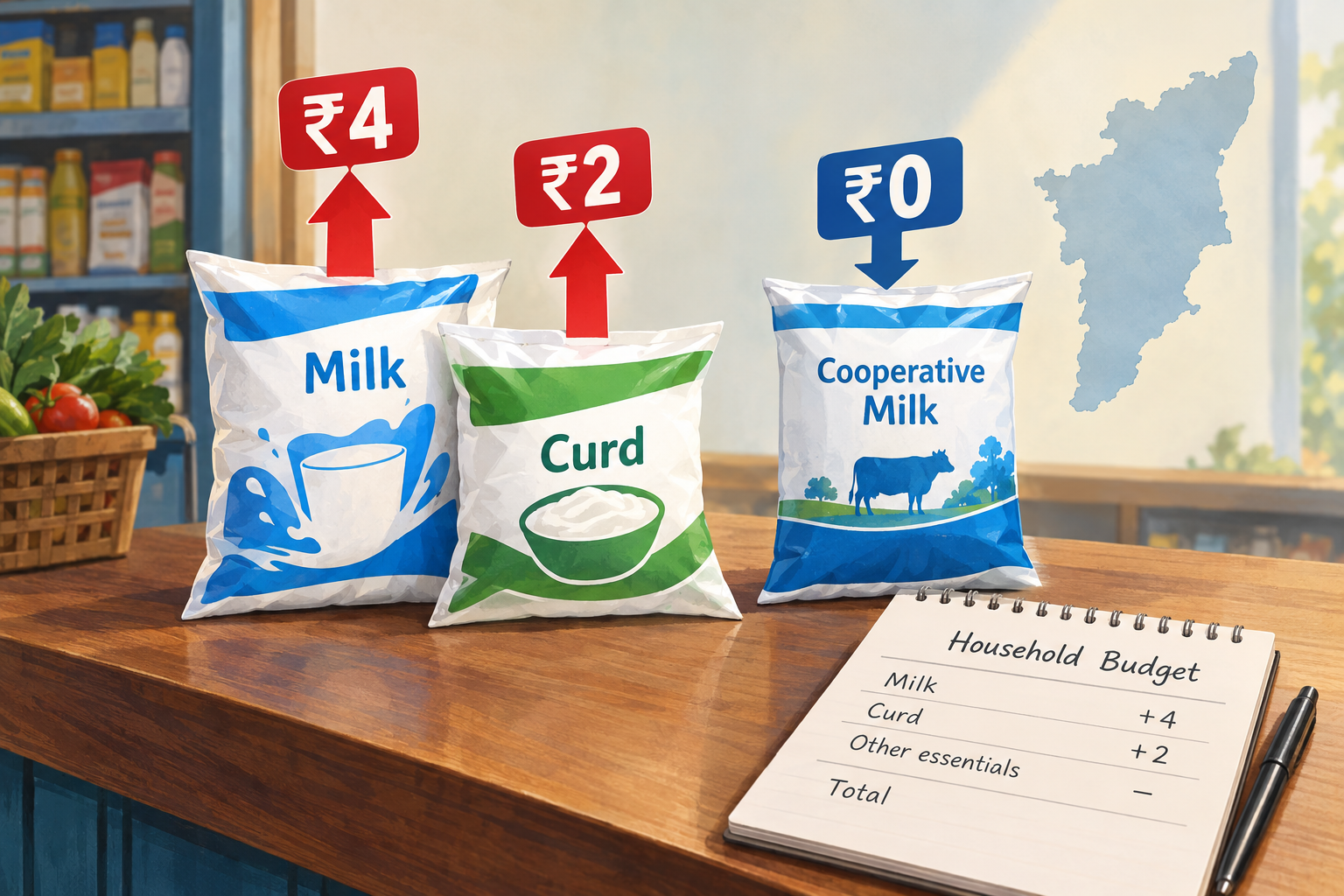
Households across Tamil Nadu could pay more for privately supplied milk and curd from Saturday, September 26, as several dairy companies prepare to revise their retail rates. The announced increases reach up to ₹4 per litre for milk and ₹2 per kilogram for curd, although the exact change may vary by brand, product and pack size.

The Tamil Nadu Milk Dealers and Workers Welfare Association said brands including Dodla, Heritage, Tirumala, Srinivasa, Vallabha and Jersey are expected to introduce revised prices. Arokya had already increased its milk price by ₹4 per litre and curd price by ₹2 per kilogram from September 21.
Expected private milk and curd prices
Under the proposed rate structure, a one-litre pack of toned milk will cost ₹61, compared with ₹59 earlier. Standardised milk is expected to rise from ₹68 to ₹70 per litre, while full-cream milk will increase from ₹78 to ₹81.
| Product | Earlier price | Expected price |
|---|---|---|
| Toned milk, 1 litre | ₹59 | ₹61 |
| Standardised milk, 1 litre | ₹68 | ₹70 |
| Full-cream milk, 1 litre | ₹78 | ₹81 |
| Toned milk, 500 ml | ₹31 | ₹32 |
| Standardised milk, 500 ml | ₹35 | ₹37 |
| Full-cream milk, 500 ml | ₹40 | ₹42 |
| Toned curd, 500 grams | ₹41 | ₹42 |
| Double-toned curd, 500 grams | ₹36 | ₹37 |
The per-litre increase is not identical across all varieties. The largest change in the published price list is for full-cream milk, while smaller packs may rise by ₹1 or ₹2. Other curd pack sizes could reflect the broader increase of up to ₹2 per kilogram.
Why private dairies are raising prices
The industry’s stated reason is a rise in the cost of procuring raw milk from farmers. The Tamil Nadu government recently increased Aavin’s procurement rate for cow milk from ₹38 to ₹44 per litre and for buffalo milk from ₹47 to ₹53, effective September 1.
Private dairies argue that they must offer competitive procurement rates to retain farmers, particularly when the state-supported cooperative is paying more. Unlike Aavin, private companies do not receive an equivalent government-backed incentive for procurement. They therefore say that part of the additional cost must be passed on through retail prices.
Aavin’s revised cow-milk procurement rate includes a base price of ₹36 and an incentive of ₹8 per litre. The state has committed annual funding for that incentive, allowing the cooperative to pay producers more without immediately increasing the price charged to consumers.
How private prices compare with Aavin
Aavin has kept its retail milk prices unchanged despite the higher procurement rates. The milk dealers’ association estimates that private milk will now cost between ₹14 and ₹30 more per litre than comparable Aavin varieties, depending on fat content and product category.
The widening difference could encourage more consumers to seek Aavin packets. However, availability can vary by locality and product type, particularly during morning demand. Consumers should compare like-for-like varieties rather than relying only on packet colour or the headline price, because toned, standardised and full-cream milk contain different levels of fat.
What consumers should check from September 26
- Read the printed MRP: Check the price on each packet instead of assuming every private brand has introduced the same increase.
- Confirm the quantity: Compare 500-ml packs with one-litre packs and 500-gram curd packets with one-kilogram rates.
- Check the milk variety: Toned, standardised, double-toned and full-cream products have different prices and should not be compared as identical products.
- Review subscriptions: Households using monthly delivery services should ask when the revised rate begins and whether prepaid orders are affected.
- Request a bill: The amount charged should correspond with the MRP printed or officially marked on the packet.
- Watch for brand and location differences: Implementation may not be uniform across every shop or city on the first day.
For families buying two litres of private milk a day, a ₹4-per-litre increase would add about ₹240 to a 30-day household bill. The actual impact will depend on the chosen brand, milk variety and daily consumption.