
Tarang Shakti 2026 Opens in Jodhpur as US F-35s Join Multinational Drills
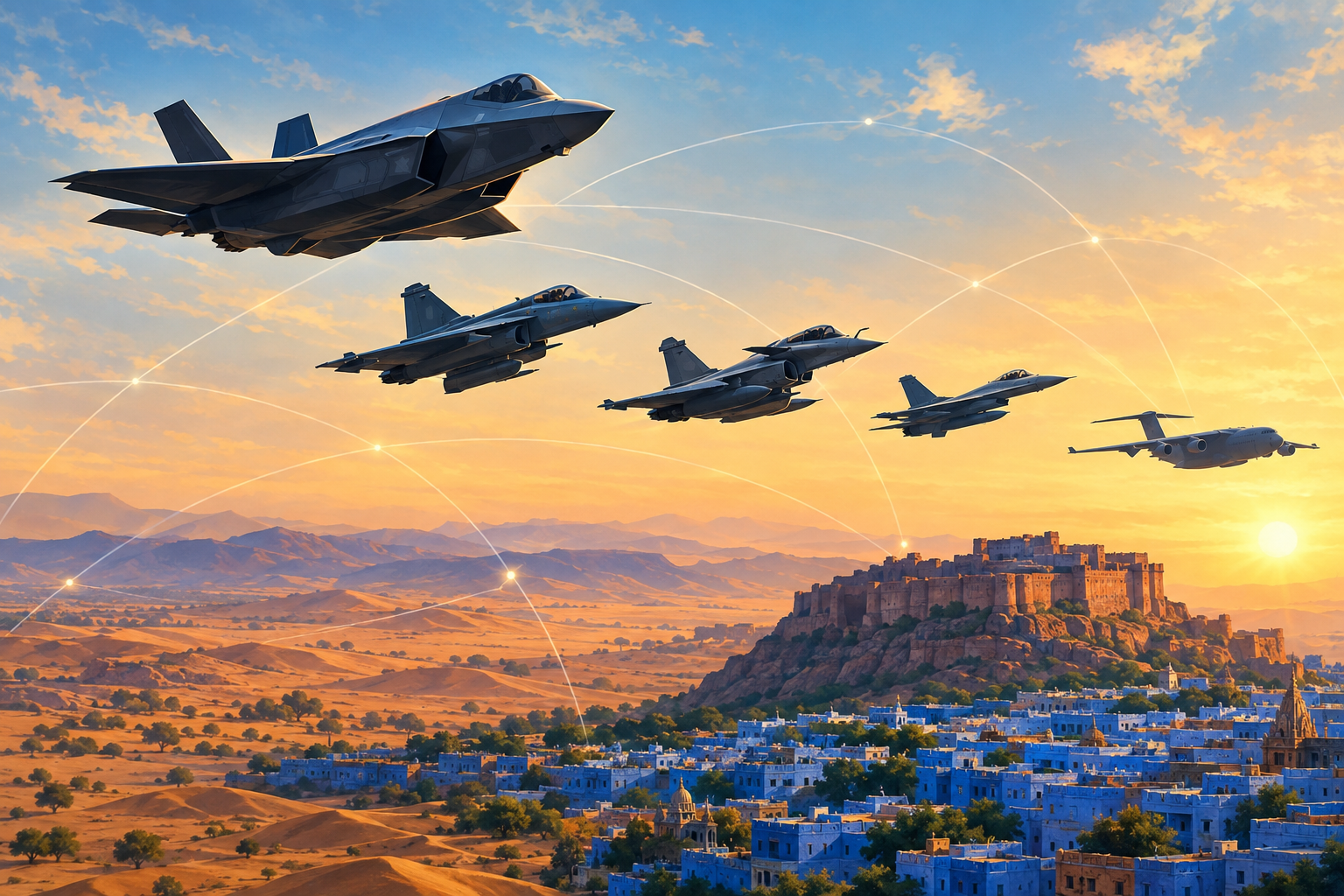
The Indian Air Force has begun Tarang Shakti 2026 at Air Force Station Jodhpur and adjoining bases in Rajasthan, opening more than two weeks of multinational aerial training. The exercise, scheduled from September 26 to October 12, is the second edition of India’s largest multilateral air drill and is expected to involve more than 80 Indian and foreign aircraft.

Approximately 1,500 pilots, technicians, mission planners and other personnel are expected to participate. Rather than functioning as a flying display, Tarang Shakti is intended to test how air forces with different aircraft, procedures and communication systems can plan and execute missions together in a demanding operational environment.
Which countries are participating?
The detailed foreign aircraft roster released for the opening names seven flying partners: Australia, Bangladesh, France, Germany, Sri Lanka, the United Arab Emirates and the United States. Another 32 countries are attending as observers, giving the exercise a diplomatic reach extending well beyond the nations deploying aircraft.
Australia and Bangladesh are contributing C-130-family transport aircraft, while Germany is sending A400M airlifters. Sri Lanka’s contingent includes a King Air aircraft. France is bringing Rafale fighters, A400M transports and A330 multi-role tanker transports, allowing it to participate across combat, mobility and aerial-refuelling missions.
The UAE is expected to field F-16 fighters and a Global 6000-based specialised aircraft. The United States is contributing F-35A fighters and KC-135 aerial-refuelling tankers. India’s participating fleet is expected to include Rafale, Su-30MKI, Tejas, Mirage 2000, MiG-29 and Jaguar fighters, supported by transport, surveillance and tanker aircraft.
Some initial official summaries also named Greece, producing an eight-country foreign-participant count. However, the detailed deployment roster available at the start of the exercise did not identify a Greek aircraft contingent. The seven-country flying list therefore provides the clearest picture of the actively deployed foreign assets.
What will the F-35s do?
The expected arrival of six US Air Force F-35As is the most closely watched element of Tarang Shakti 2026. F-35s have previously appeared at India’s Aero India exhibition, but this is expected to be the first time the fifth-generation stealth fighter has participated in an operational military exercise on Indian soil.
The aircraft are expected to fly within multinational mission packages alongside, and in some scenarios against, Indian and partner aircraft. The planned training includes counter-air operations, air defence, reconnaissance, airlift, force protection, aerial refuelling and complex missions involving several aircraft types.
For Indian crews, the value lies in gaining direct experience of operating in an exercise environment that includes a stealth aircraft designed around advanced sensors, data fusion and networked warfare. Sensitive performance details and tactics will remain protected, but even controlled interaction can improve mission planning, detection procedures, airspace coordination and understanding of fifth-generation operations.
The F-35 deployment should not automatically be interpreted as an Indian procurement decision. Its immediate purpose is operational training and military engagement, although the aircraft’s presence will inevitably attract attention as India considers the long-term composition of its combat fleet and continues work on its indigenous Advanced Medium Combat Aircraft programme.
Why Tarang Shakti matters
Tarang Shakti gives India an opportunity to build practical interoperability without joining a formal military alliance. Participating forces must coordinate flight safety, refuelling, command arrangements, mission planning and tactical responsibilities despite operating different aircraft and national systems. Those habits can become valuable during humanitarian relief, evacuation operations, maritime-security missions or future coalition deployments.
The exercise also supports India’s airpower diplomacy. Hosting advanced foreign aircraft places the IAF at the centre of a network that includes partners from South Asia, Europe, the Gulf and the Indo-Pacific. Observer participation allows additional governments to study Indian training methods and examine the country’s expanding aerospace and defence-industrial capabilities.
For regional security, the drill demonstrates India’s ability to receive, support and coordinate substantial foreign deployments from its own bases. It also provides experience in managing increasingly complex air operations at a time when long-range weapons, drones, electronic warfare, stealth technology and networked sensors are changing the character of aerial combat.
Tarang Shakti is therefore significant for more than the collection of fighters on the Jodhpur flight line. Its larger purpose is to strengthen professional relationships, expose Indian personnel to different operational concepts and establish India as a credible convening power in multinational air training.