India Reach 27 Medals as Barwal, Shooters and Squash Players Add to Asian Games Haul
India’s medal count at the 2026 Asian Games climbed to 27 on Saturday, September 26, after a productive run across athletics, shooting, squash and kabaddi in Aichi-Nagoya.

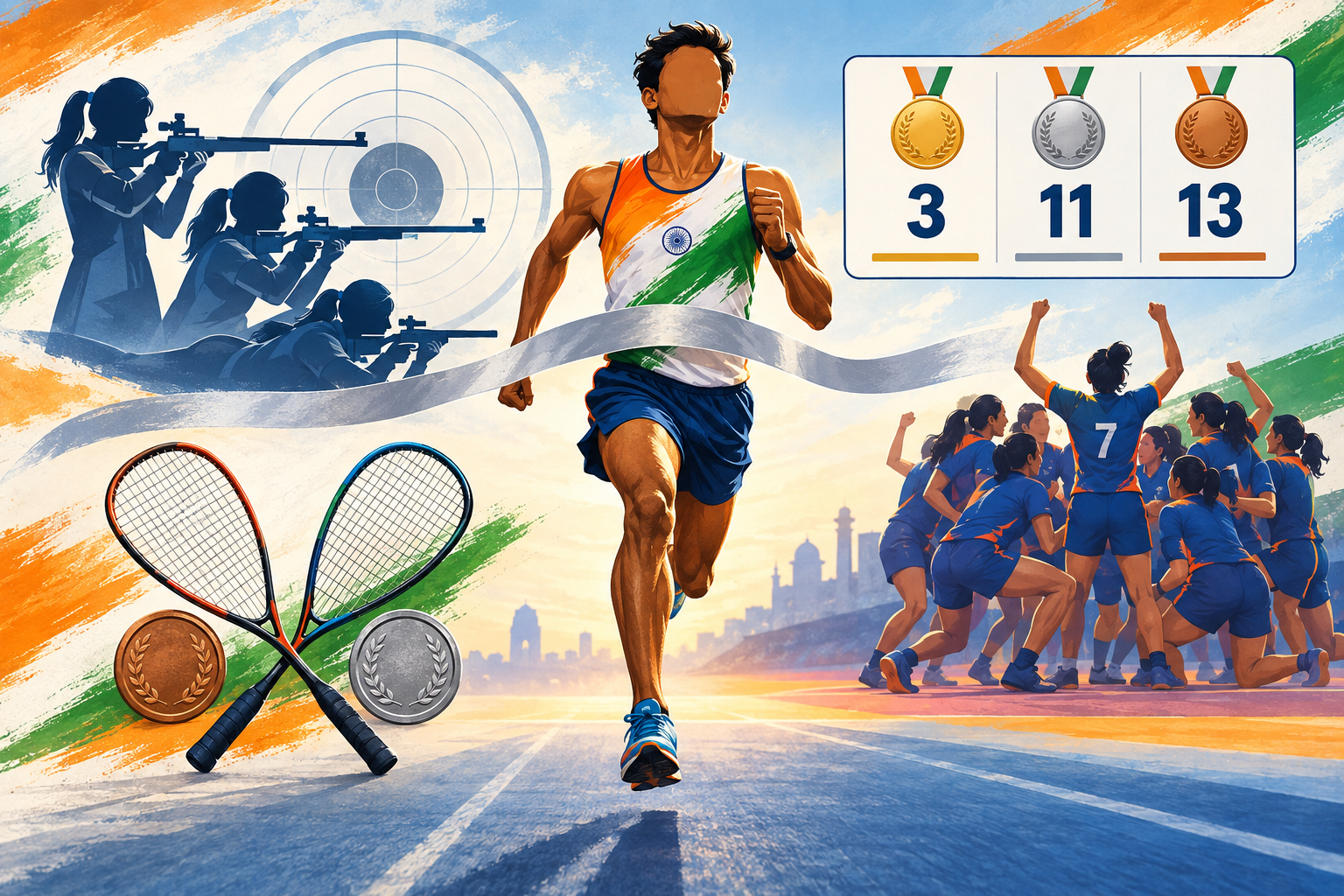
Following the women’s kabaddi final, the official running tally stood at three gold, 11 silver and 13 bronze medals, placing India 12th in the standings at that point. The figure remains a live snapshot because several Indian athletes and teams are still competing in medal rounds.
Barwal ends India’s 44-year marathon wait
Sawan Barwal delivered the day’s landmark result by taking silver in the men’s marathon. The 28-year-old clocked 2 hours, 11 minutes and 37 seconds, improving the national record and securing India’s first Asian Games marathon medal since 1982.
Barwal stayed among the leaders throughout the race and held second place through its decisive stages. Japan’s Ichitaka Yamashita won gold in 2:10:49, while China’s Feng Peiyou claimed bronze in 2:12:13.
The result carries significance beyond the colour of the medal. Marathon success has been rare for India at the Asian Games, and Barwal’s performance provided an early boost on a day packed with medal opportunities.
Women shooters collect another silver
India’s shooters continued to supply a substantial share of the country’s medals. Tilottama Sen, Vidarsa K. Vinod and Ashi Chouksey combined for silver in the women’s 50m rifle three positions team event.
The trio registered 1,763 points with 90 inner tens. China took gold with 1,773, while Kazakhstan finished third. Tilottama led the Indian scoring with 590, and both she and Vidarsa advanced to the individual final.
The team silver raised shooting’s contribution to 11 medals at this edition at the time of the result: one gold, six silver and four bronze. That made it India’s leading medal-producing sport during the opening half of the Games.
Squash produces one medal and guarantees two more
Joshna Chinappa and Velavan Senthilkumar secured bronze in the squash mixed doubles after a closely fought 2-1 semifinal defeat against Hong Kong’s Tang Ming Hong and Lee Ka Yi. For the 40-year-old Chinappa, it was a sixth Asian Games medal across a long continental career.
India also received a major lift in singles. Anahat Singh completed a dramatic comeback against Japan’s Satomi Watanabe to reach the women’s final, while Abhay Singh advanced to the men’s title match. Both are therefore guaranteed at least silver medals, although those medals were not included in the 27-medal snapshot because the finals had not yet been completed.
The two singles finals are scheduled for Sunday, giving India opportunities to convert both guaranteed medals into gold.
Kabaddi victory takes India to three gold
India’s women defeated Iran 37-34 in a tense kabaddi final to retain their Asian Games title. The victory supplied India’s third gold of the campaign, following the women’s cricket triumph and the mixed-team 10m air pistol title won by Suruchi Singh Phogat and Kamaljeet.
The men’s kabaddi team was due to face Iran later on Saturday, offering another immediate chance to increase the gold-medal count.
What remains for India
Beyond kabaddi and the squash finals, India still has medal opportunities in athletics, archery, badminton, boxing, wrestling, hockey, table tennis and men’s cricket, among other sports. The Games run until October 4, meaning the current total represents only an interim measure of the overall campaign.
Athletics is expected to become increasingly important as more track and field finals are contested. India will also look to its traditional strengths in archery, hockey, wrestling and the later combat-sport events to improve both the total medal count and the number of golds.
How the campaign compares
India entered Aichi-Nagoya after its record-breaking performance at the previous Asian Games in Hangzhou, where it finished fourth with 107 medals: 28 gold, 38 silver and 41 bronze. That was a major improvement on the 70 medals, including 16 gold, credited to India from the 2018 Jakarta-Palembang Games after subsequent medal reallocations.
With 27 medals and three golds in the current snapshot, India remains well short of those final totals. However, a direct comparison is premature because many medal-rich events are still unfinished. The more immediate test is whether the guaranteed squash medals, the kabaddi final and the second-half programme can produce the sustained gold-medal run needed to move India toward the upper section of the table.