Sawan Barwal Runs Into History With Asian Games Marathon Silver
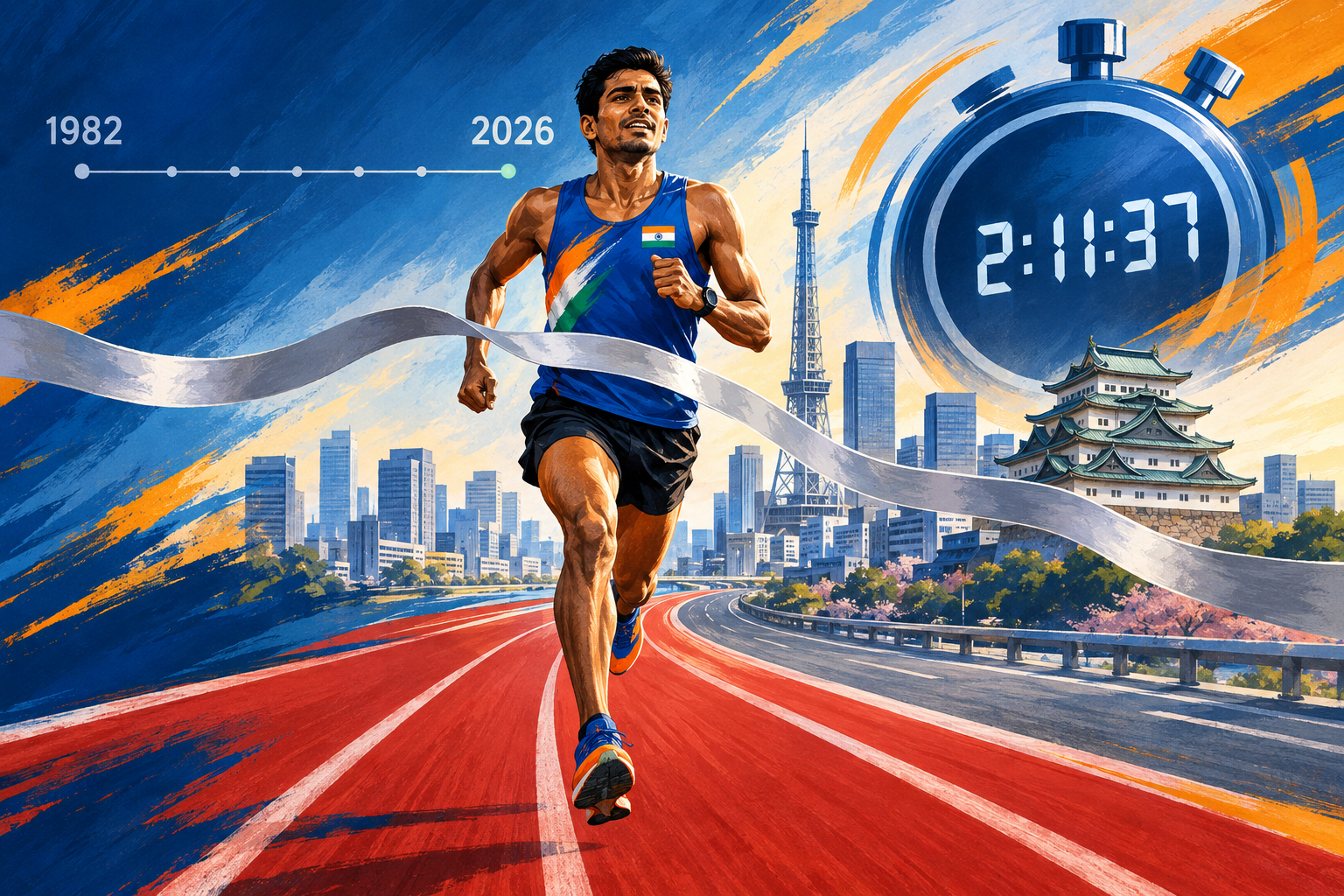
Sawan Barwal delivered a landmark result for Indian distance running on Saturday, winning the men’s marathon silver medal at the 2026 Asian Games in Nagoya with a national-record time of 2 hours, 11 minutes and 37 seconds.

The 28-year-old finished behind Japan’s Ichitaka Yamashita, who claimed gold in 2:10:49 after breaking away during the closing stages. China’s Feng Peiyou took bronze in 2:12:13, while India’s Kartik Karkera finished 17th in 2:22:41.
Barwal remained among the leaders throughout the 42.195-kilometre race. He reached halfway alongside Yamashita in 1:05:54 and continued to challenge near the front through 35 kilometres. The Japanese runner eventually established the decisive gap, but Barwal maintained his rhythm and composure to secure silver, finishing 48 seconds behind the winner.
A 44-year wait comes to an end
The result gave India its first Asian Games men’s marathon medal since Hosur Kukkappa Seetharan won bronze at the 1982 New Delhi edition. Before that, Chhota Singh earned gold and Surat Singh Mathur took bronze when India hosted the inaugural Asian Games in 1951.
Barwal is therefore only the fourth Indian man to reach an Asian Games marathon podium. He is also the first to do so outside India, adding another layer of significance to a performance achieved against a strong continental field and a home favourite.
The 44-year gap illustrates how difficult sustained success in the marathon has been for India. The event demands not only speed and endurance but also years of preparation, careful recovery, disciplined nutrition and the ability to make decisions while fatigue builds over more than two hours.
From track laps to marathon history
What makes Barwal’s achievement especially striking is the speed of his transformation. He spent much of his career competing over 5,000 metres and 10,000 metres, developing the pace, efficiency and competitive awareness required for track racing. He also built road-racing experience over the half-marathon and 25-kilometre distances, including an Asian half-marathon bronze in 2023.
The possibility of moving up to the marathon was first seriously discussed in 2023 and became a clearer objective after the 2025 Asian Athletics Championships. A planned debut later that year was abandoned after an injury shortly before the race, forcing Barwal to pause and rebuild.
He returned to structured training in January 2026. The transition required more than simply extending his usual runs. His preparation had to be reshaped around longer endurance sessions, marathon-specific pace work, fuelling, recovery and the mental challenge of continuing beyond the 35-kilometre point, where the distance can punish even highly trained athletes.
Barwal finally made his competitive marathon debut in Rotterdam on April 12. He completed the race in 2:11:58, becoming the first Indian to run under 2:12 and breaking Shivnath Singh’s national record of 2:12:00, which had stood since 1978.
Just over five months later, in only his second marathon, Barwal lowered that mark by another 21 seconds while winning an Asian Games silver medal.
Why the silver matters
The performance provides Indian distance running with a result that is both historic and forward-looking. Barwal has shown that the country’s leading track and road runners can make a successful move to the marathon when their development is supported by patient planning, scientific preparation and consistent high-level competition.
His progress also challenges the idea that Indian marathon standards must remain separated from the leading performances in Asia. The record had remained untouched for nearly five decades before Barwal broke it in his debut. He has now improved it again under championship pressure, where medals matter more than perfectly controlled pacing.
The next benchmark will be the 2:10 barrier, but Nagoya was about more than a number. Barwal arrived as a newcomer to the event and left as an Asian Games medallist, ending one of India’s longest waits in athletics.
For a runner who was still primarily associated with track events a short time ago, the journey from 5,000-metre and 10,000-metre races to a national record and continental silver represents an unusually rapid breakthrough. For Indian distance running, it offers evidence that another level may now be within reach.