Why Mumbai Ranks Eighth in Global Prime Home Price Growth
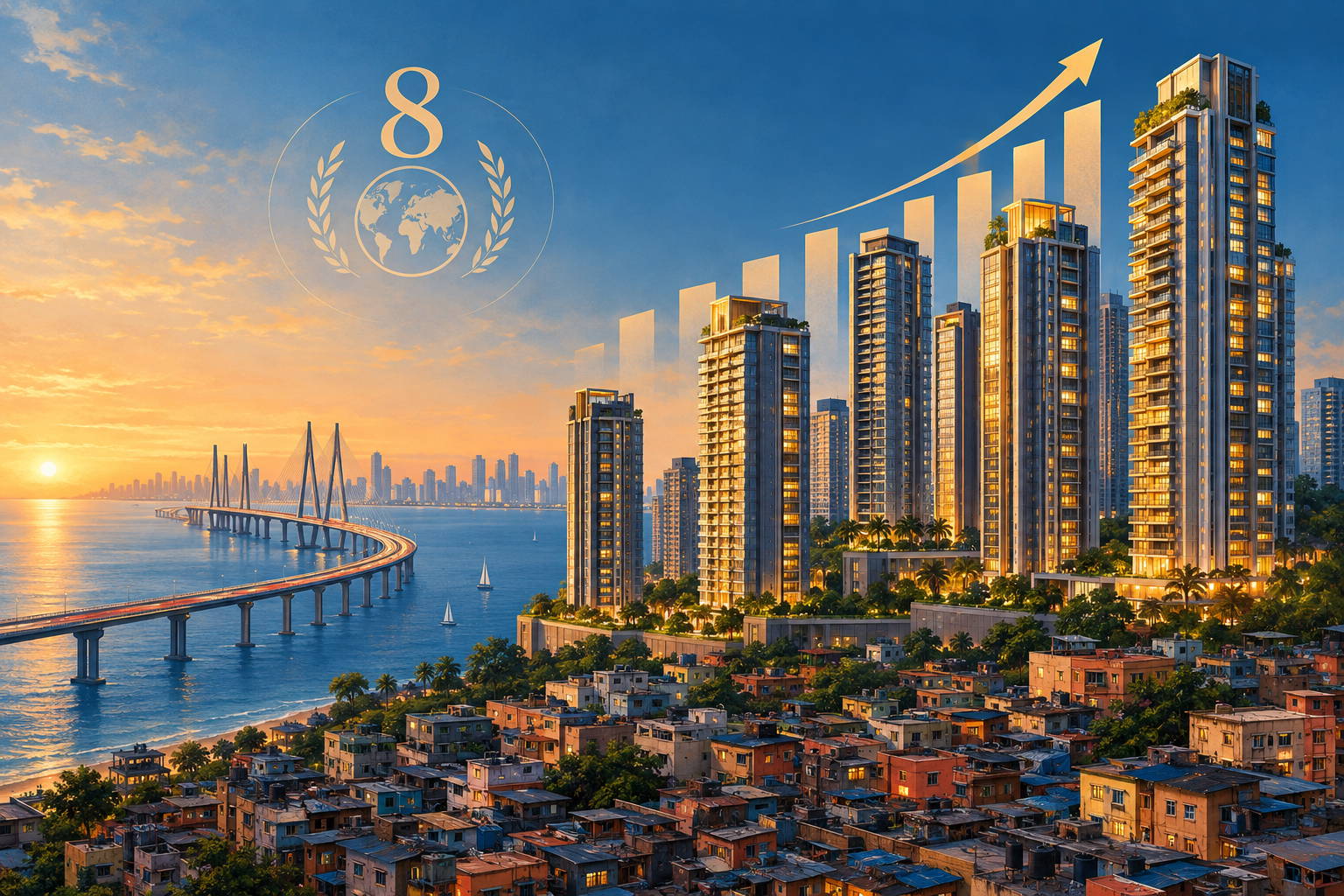
Mumbai placed eighth in the Prime Global Cities Index for the second quarter of 2026 after the value of its prime homes increased 6.2% from a year earlier. That was more than twice the index-wide annual growth rate of 2.6%, confirming that the upper end of the city’s housing market remains resilient despite already elevated prices.

The ranking needs careful interpretation. It measures the rate of price change in prime residential property, generally the most desirable and expensive part of each city’s market. It does not mean Mumbai is the world’s eighth-most-expensive city, nor does it suggest that every home across the Mumbai Metropolitan Region appreciated by 6.2%.
Why Mumbai finished eighth
Seven cities recorded faster annual growth. Tokyo led with a striking 50.7% increase, followed by Manila at 14.6%. Dubai, Singapore, Nairobi, Christchurch and Seoul also finished ahead of Mumbai. Vienna and San Francisco completed the top 10 behind it.
Mumbai’s prime prices also rose 1.7% between the first and second quarters of 2026. This indicates that the annual increase was not solely a result of gains made earlier in the comparison period, although the quarterly pace was less dramatic than in some leading markets.
The city had ranked sixth with annual growth of 8.7% in Q2 2025. Its move to eighth therefore reflects slower appreciation as well as stronger performances elsewhere, rather than an outright weakening of prime property values.
Among the Indian cities in the latest ranking, Mumbai remained the strongest performer. Bengaluru placed 12th after prices rose 4.5%, while New Delhi ranked 17th with growth of 3.9%.
The neighborhoods supporting demand
Activity is concentrated in a relatively narrow luxury corridor. Worli is a major driver, combining sea views, newer towers, large apartments and improved connections to South Mumbai and the western suburbs. Transactions involving homes priced above ₹10 crore were especially strong there during the first half of 2026.
Tardeo, Lower Parel and Prabhadevi form another important cluster. These neighborhoods offer modern developments near established business districts, giving buyers an alternative to older buildings in traditional South Mumbai locations.
Malabar Hill, Cumbala Hill, Nepean Sea Road, Altamount Road and adjoining precincts retain their appeal because developable land and new inventory are exceptionally limited. In these areas, a small number of transactions can establish new price benchmarks for an entire micro-market.
Bandra West remains the preferred suburban luxury address for many entertainment executives, entrepreneurs and professionals. Its combination of restaurants, schools, coastal locations and access to commercial districts supports demand even when sales volumes fluctuate. Juhu, Khar and Santacruz also benefit from buyers seeking larger or newer homes without moving to South Mumbai.
Who is buying
The strongest demand is coming from high-net-worth and ultra-high-net-worth households rather than mortgage-dependent mass-market buyers. Established business families are consolidating relatives into larger apartments or buying multiple adjoining units. Entrepreneurs, corporate leaders and senior professionals are upgrading to homes with more space, security and managed amenities.
Non-resident Indians and internationally mobile buyers form another segment, particularly for completed or easily managed properties. Domestic investors, family offices and wealthy buyers seeking a long-term store of value also support prices, although end-user upgrades remain central to the market.
Buyer expectations have changed as well. Sea views and prestigious addresses still matter, but purchasers increasingly want private lifts, wellness facilities, concierge services, club spaces, extensive parking and professionally managed buildings. Scarcity is therefore not simply about land; it also applies to homes meeting current luxury standards.
A sharp affordability divide
The 6.2% rise highlights the widening gap between Mumbai’s prime market and its mainstream housing needs. An affordability assessment for the first half of 2026 estimated that a typical Mumbai Metropolitan Region household would need to devote about 69% of its income to the monthly instalment on a representative home. A ratio above 50% is generally treated as unaffordable.
Lower borrowing costs have offered some relief, but they have not offset high land values, construction costs and limited supply in well-connected locations. As developers focus on premium projects, middle-income buyers face smaller homes, longer commutes or a shift towards Thane, Navi Mumbai and outer metropolitan areas.
Mumbai’s global ranking is therefore best understood as evidence of concentrated wealth and scarcity, not universal housing-market strength. Prime values are being sustained by affluent buyers competing for a limited pool of high-quality homes, even as ownership becomes harder for much of the city’s salaried population.