
Banks Open Sunday Before September 28-30 Strike: Services and Full List
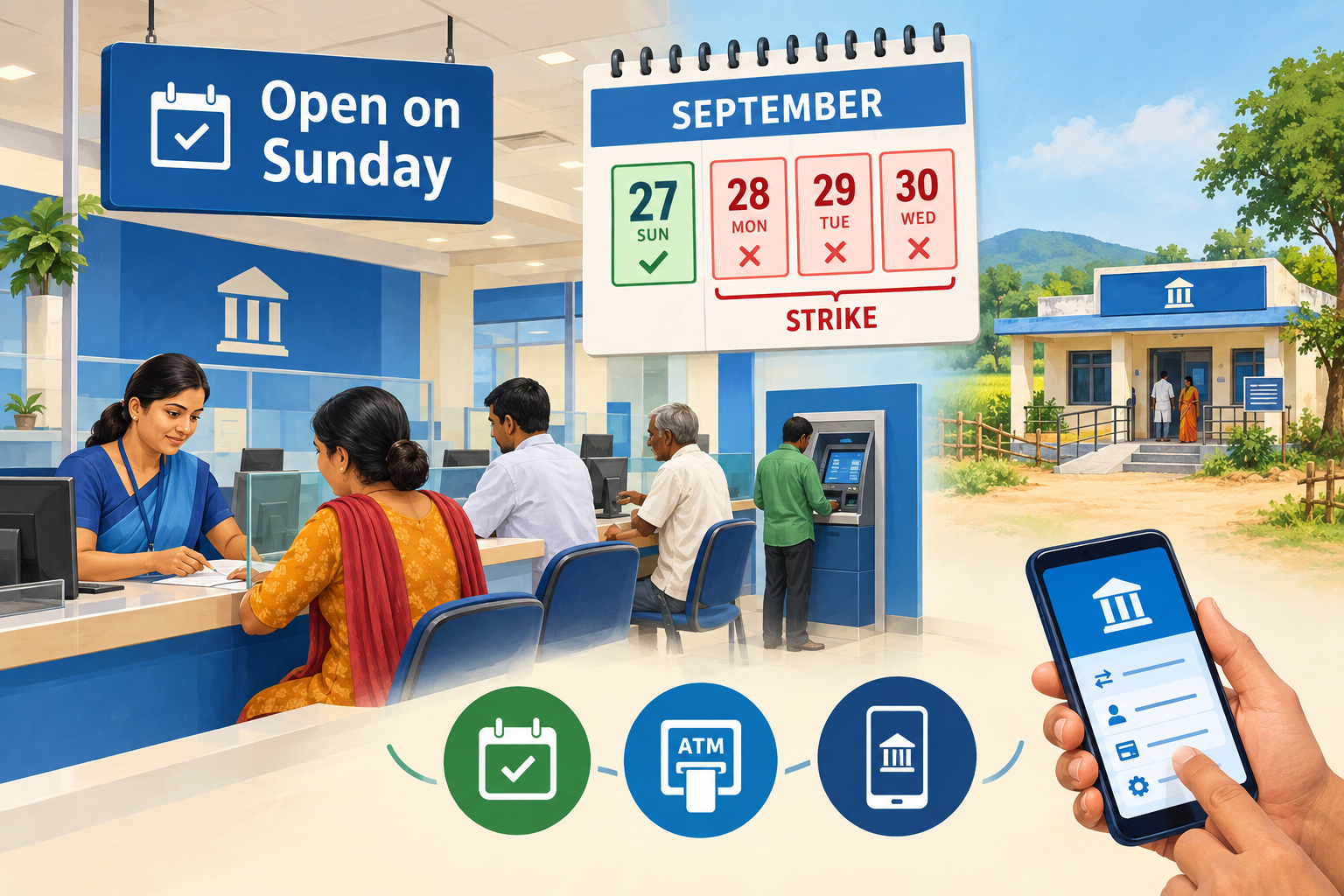
Public-sector banks and regional rural banks across India have been directed to function normally on Sunday, September 27, 2026, under an unusual arrangement approved by the Reserve Bank of India. The special opening gives customers an opportunity to complete branch-dependent work before the proposed nationwide bank strike from Monday, September 28, through Wednesday, September 30.

The official direction covers bank branches, administrative offices, ATM-link branches and currency chests. However, customers planning an important visit should still confirm local opening hours because staffing arrangements, union instructions and operational conditions may differ at individual branches.
Which public-sector banks are open?
The Sunday working arrangement covers all 12 public-sector banks:
- Bank of Baroda
- Bank of India
- Bank of Maharashtra
- Canara Bank
- Central Bank of India
- Indian Bank
- Indian Overseas Bank
- Punjab & Sind Bank
- Punjab National Bank
- State Bank of India
- UCO Bank
- Union Bank of India
Private-sector banks are not automatically covered by the government’s public-sector opening announcement. Customers of private, cooperative, small finance or foreign banks should check directly with their bank before travelling.
Which regional rural banks are covered?
All 28 regional rural banks are included:
- Andhra Pradesh Grameena Bank
- Arunachal Pradesh Rural Bank
- Assam Gramin Bank
- Bihar Gramin Bank
- Chhattisgarh Gramin Bank
- Gujarat Gramin Bank
- Haryana Gramin Bank
- Himachal Pradesh Gramin Bank
- Jammu and Kashmir Grameen Bank
- Jharkhand Gramin Bank
- Karnataka Grameena Bank
- Kerala Grameena Bank
- Madhya Pradesh Gramin Bank
- Maharashtra Gramin Bank
- Manipur Rural Bank
- Meghalaya Rural Bank
- Mizoram Rural Bank
- Nagaland Rural Bank
- Odisha Grameen Bank
- Puducherry Grama Bank
- Punjab Gramin Bank
- Rajasthan Gramin Bank
- Tamil Nadu Grama Bank
- Telangana Grameena Bank
- Tripura Gramin Bank
- Uttar Pradesh Gramin Bank
- Uttarakhand Gramin Bank
- West Bengal Gramin Bank
Why are banks opening on a Sunday?
September 26 was the fourth Saturday of the month, when banks are ordinarily closed, and September 27 would normally be a Sunday holiday. If the September 28-30 strike proceeds, customers could otherwise face five consecutive days of limited access to public-sector and rural bank branches.
The government approved the Sunday opening to reduce that disruption and allow essential transactions to be completed beforehand. September 30 is also the half-yearly closing date for banks, making uninterrupted reconciliation, provisioning, treasury and market-related operations particularly important. The government and bank managements have appealed to the unions to defer the strike.
What services can customers access on September 27?
Because the covered banks have been asked to operate normally, customers should generally be able to use regular counter and account services, including:
- Cash deposits and over-the-counter withdrawals
- Cheque deposits and presentation
- Demand drafts and pay orders
- Fixed-deposit renewals and account servicing
- KYC updates and document submission
- Loan applications, repayments and paperwork
- Passbook updates and assisted banking
- Locker access, subject to branch arrangements
ATM-link branches and currency chests are also permitted to operate, helping banks replenish cash and support ATM availability. Customers with urgent cheque, cash or documentation work should complete it on Sunday rather than wait for the strike period.
What could be affected during the strike?
The United Forum of Bank Unions has proposed the September 28-30 action primarily over the demand for a five-day banking week. The unions say the change was recommended following a March 2024 settlement but is still awaiting implementation. They have also raised recruitment, pension and other service-related matters. The government says a separate dispute over a performance-linked incentive scheme has been addressed by keeping that scheme in abeyance.
If employees participate widely, public-sector and regional rural bank branches may experience closures, reduced staffing or long queues. Counter withdrawals and deposits, cheque processing, demand drafts, locker visits, loan documentation and other transactions requiring employee intervention could be delayed. Cheque settlement and back-office processing may also take longer than usual.
UPI, IMPS, mobile banking, internet banking, card payments, NEFT and RTGS are generally expected to remain available because they largely operate through automated systems. ATMs should also continue functioning, although cash availability could become uneven if replenishment is delayed. Customers should keep alternative payment options ready and avoid leaving time-sensitive branch work until the strike dates.