
India’s Monsoon Ends 12.6% Below Average, With Sharp Regional Gaps
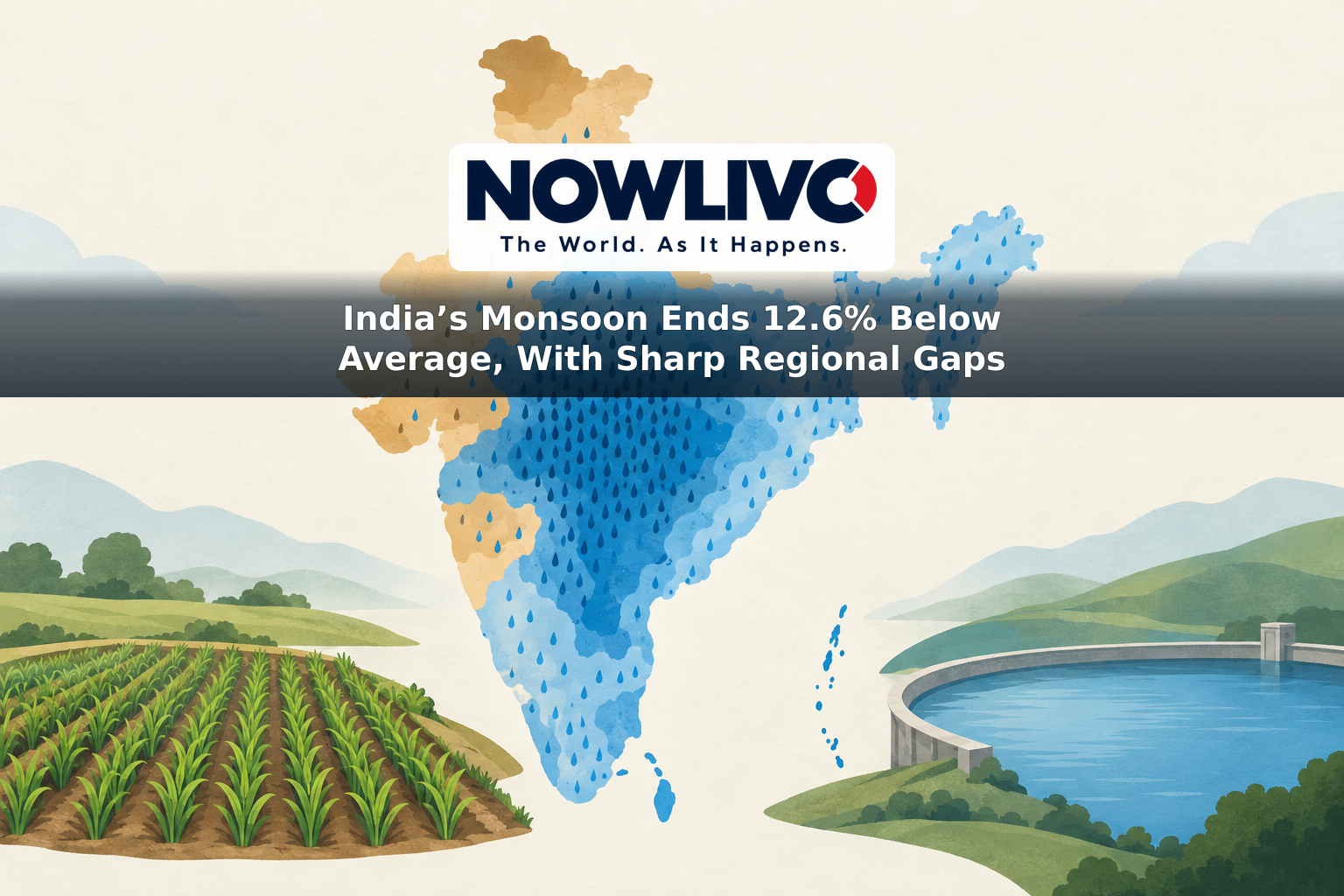
India received 12.6% less rainfall than average during the June–September 2026 monsoon, a senior India Meteorological Department official said on September 30. The season was the country’s driest in more than a decade. But the nationwide figure tells only part of the story: rainfall was much closer to normal in some regions than in others, leaving farmers and water managers facing different conditions as the main rainy season ends.
The shortfall matters because monsoon rain supports summer-grown crops and helps replenish reservoirs and groundwater used beyond September. It does not, by itself, establish how much food will be harvested, whether households will face water restrictions or what shoppers will pay. Those outcomes depend on where rain fell, when it arrived, irrigation access and the condition of local water stores.
A national deficit, unevenly shared
India Meteorological Department data through September 29 showed the widest broad regional deficits in east and northeast India and the southern peninsula, each roughly a quarter below its usual rainfall. Northwest India was much nearer its seasonal average, while central India was closer still. Those regional averages also conceal large differences between neighboring states.
In the east and northeast, Meghalaya, Manipur and Arunachal Pradesh recorded particularly steep shortfalls through September 29. Bihar and Assam were also substantially below average. Yet Sikkim and West Bengal were above their respective averages. In the northwest, Punjab and Haryana had sizable deficits even though rainfall across the broader region was only modestly below normal. Odisha, meanwhile, had more rain than usual despite the countrywide deficit.
The distinction is important when assessing consequences. A national percentage cannot show whether rain missed a crop at a crucial stage, whether a district received enough water to refill storage or whether a heavy downpour arrived too quickly to be useful. Nor should a September 29 regional tally be treated as an exact final figure for every state: it is a snapshot from the day before the season’s closing assessment.
What farmers may face
Summer-sown crops rely on rainfall at several points, from planting and early growth to the weeks before harvest. In places with persistent shortfalls, farmers may need more irrigation or may find that soil moisture has been insufficient for particular crops. A late spell of rain can help some fields, but it cannot necessarily make up for water that was missing earlier in the growing season.
Conditions will differ by crop and district. Farmers with reliable irrigation have options that rain-dependent growers do not, while the timing of dry spells can be as consequential as the seasonal total. The India Meteorological Department had warned in its 2026 monsoon outlook that below-normal rain could challenge agriculture and called for contingency planning. The rainfall result makes that warning relevant, but it is not a measure of crop losses. Harvest and production assessments will be needed before the scale of any damage is clear.
Water supplies and household costs
Monsoon rainfall also feeds reservoirs and groundwater systems that support irrigation and drinking-water supplies. India’s Central Ground Water Board has identified monsoon rain as a major contributor to annual groundwater recharge. Where rain has been scarce, water managers may have less room to meet competing demands after the season. Where storage began the monsoon in better condition, or rain fell in the right catchments, the pressure may be less severe.
That is why the rainfall deficit should prompt attention to local reservoir levels, groundwater conditions and municipal supply notices rather than an assumption of nationwide household water shortages. A dry season increases the possibility of strain; it does not show that every city or village has the same amount of water available.
Food prices are another potential concern, not a settled consequence. If shortfalls reduce harvests or raise irrigation costs, some crops could become more expensive. The effect at markets would also depend on supplies from other regions, existing stocks and decisions along the distribution chain. Rainfall alone cannot support a specific price forecast.
The weather department had forecast a below-normal monsoon for 2026 and identified El Niño as a factor likely to weaken rainfall. As the season closes, the practical question is less whether India was dry on average than which districts have enough crop moisture and stored water for the months ahead. Local assessments of harvests and water reserves will provide a firmer picture of the impact than the national rainfall figure can offer on its own.