
Jaan Roose completes highline round trip 120 metres above Seoul
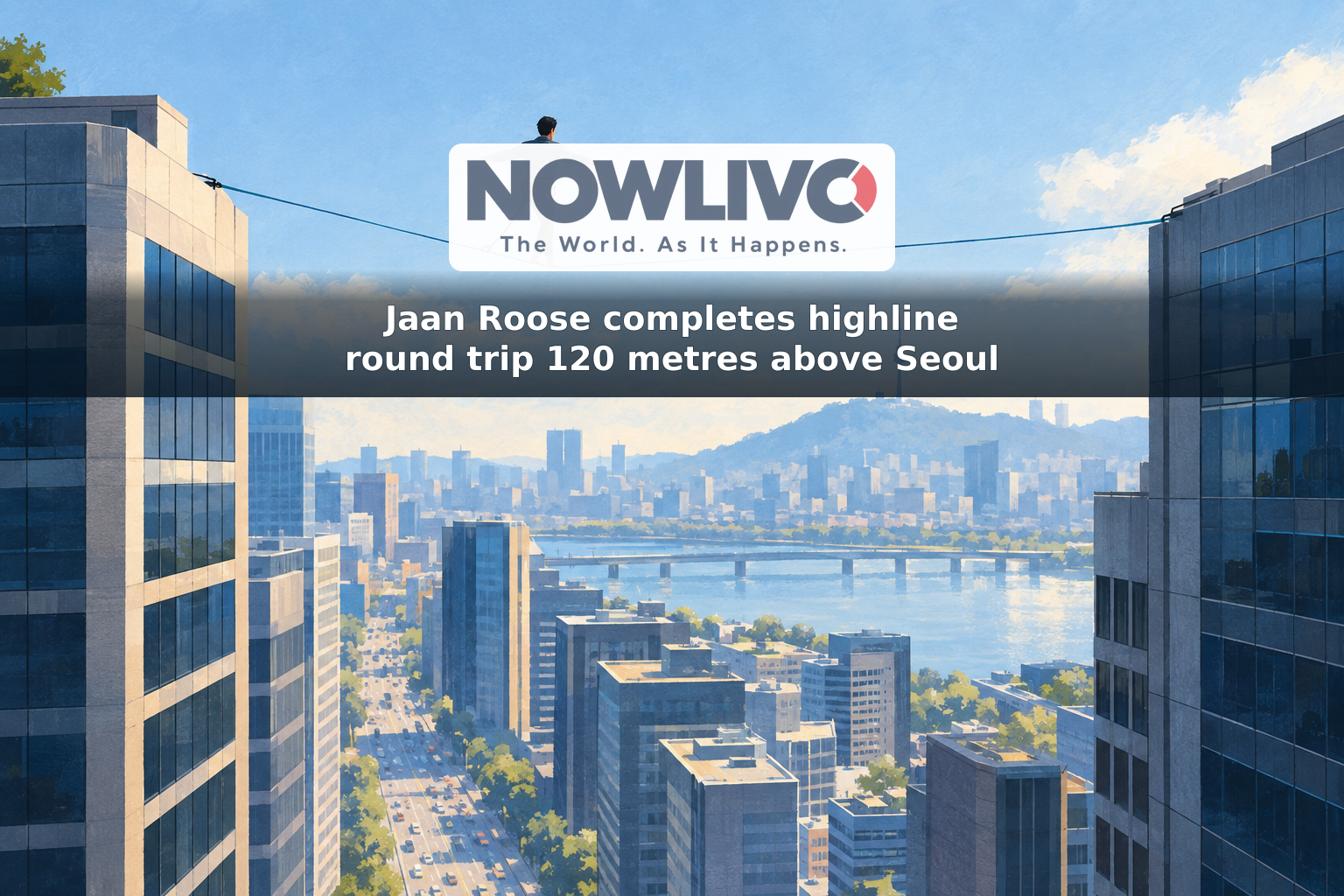
A narrow line stretched between two rooftops became a stage above central Seoul on October 1, 2026. Estonian slackliner Jaan Roose stepped onto it from the Koreana Hotel, crossed to the Dong-A Media Center and made it back to his starting point, completing a round trip on a 160-metre span suspended about 120 metres above the ground.
The outcome is no longer just a proposed feat: Roose completed the out-and-back performance. Video from the event shows him moving across the open space between the buildings, pausing for tricks as spectators watched from below. The line’s 160-metre measurement describes the distance between the rooftops, not the full distance he covered on the return trip.
A crossing above the city centre
The route passed over the Gwanghwamun area, near Cheonggye Plaza and one of Seoul’s busiest stretches of road. From street level, the line appeared as a thin strip between the Koreana Hotel and the Dong-A Media Center. Roose walked with a safety leash attached to his body; there was no net beneath the route.
Slacklining uses a narrow, flexible band rather than the rigid cable associated with conventional tightrope walking. That flexibility lets the line move under the athlete’s feet. On this crossing, Roose did more than walk from one rooftop to the other: he sat and reclined on the line and performed balancing moves during the return journey, including a handstand and hangs beneath it.
The first performance was scheduled for 1 p.m. local time, with another session planned for 4 p.m. The completed round trip establishes the outcome of the first attempt. The confirmed footage and accounts of that crossing do not, on their own, establish the outcome of the later scheduled session.
How the event was set up
Red Bull Korea organised the performance with support from the Seoul Metropolitan Government. The city described it as South Korea’s first high-altitude slackline performance of this kind. Its event plan placed the two ends of the route at slightly different heights—approximately 120 and 116 metres above the ground—and called for the rigging to undergo a safety inspection.
Weather was an explicit condition of the plan. Organisers said the crossing would stop if average wind speeds reached 10 metres per second or gusts reached 15 metres per second. At street level, viewing areas were separated from pedestrian routes and safety staff were deployed. Large outdoor screens gave people on the ground a closer view of an athlete who otherwise appeared small against the buildings.
The event also extended beyond the rooftops. Around Cheonggye Plaza, visitors were offered low-level slackline activities, alongside skateboarding and breaking performances. Those public activities provided a ground-level counterpart to a highline that spectators could watch but not approach.
What the footage shows
The Seoul city live-stream footage captures the scale of the crossing: Roose is framed against the buildings and the street far below, then seen close enough to distinguish individual movements on the line. A short video of the October 1 performance is also available, showing the crossing and midair tricks rather than merely the setup or a rehearsal. The footage makes the result clear without suggesting that he walked unsecured.
Roose is a three-time slackline world champion whose previous projects have taken him over waterways and between buildings. His Seoul appearance also had a connection to Korea’s traditional tightrope-walking culture, which he encountered during a 2022 visit. Here, that interest became a modern highline performance in the middle of the capital.
For the crowd, the drama lay in the contrast between an ordinary city afternoon and a person taking measured steps far above it. For Roose, the challenge ended where it began: back at the Koreana Hotel after crossing the span in both directions.