
SpaceX Crew-13: Who Is Aboard and How Its Fast Trip to the ISS Works
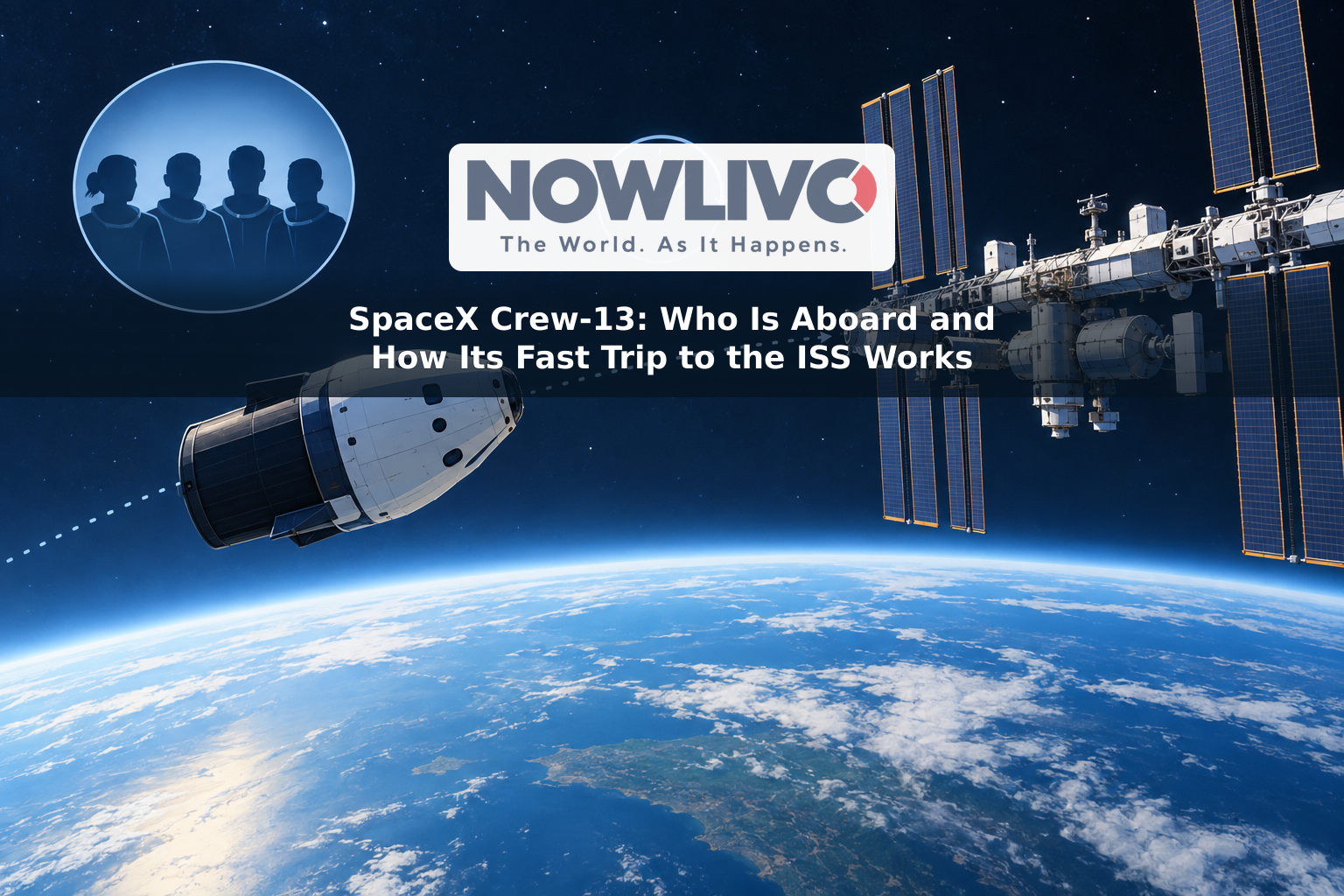
SpaceX’s Crew-13 mission launched on October 1, 2026, carrying NASA astronauts Jessica Watkins and Luke Delaney, Canadian Space Agency astronaut Joshua Kutryk, and Roscosmos cosmonaut Sergey Teteryatnikov to the International Space Station. The four will conduct research and help operate the station during a long-duration stay. Their first milestone is unusually close: Dragon is scheduled to dock at about 7 p.m. Eastern time, just seven hours and 50 minutes after its 11:10 a.m. liftoff from Cape Canaveral, Florida.
The Falcon 9 rocket lifted off from Space Launch Complex 40 at Cape Canaveral Space Force Station. Dragon separated from the rocket’s second stage and reached orbit shortly afterward. It has not yet docked with the station; the arrival time remains a target that can change as the spacecraft completes its approach.
Who is on Crew-13?
Watkins is the spacecraft commander and the only member of the quartet who has flown in space before. A geologist who worked on the Curiosity Mars rover science team, she spent 170 days aboard the station during a 2022 mission. Crew-13 is her second trip to the orbiting laboratory.
Delaney, the pilot, is a former naval aviator and test pilot who also supported airborne science missions as a NASA research pilot. This is his first spaceflight. Kutryk and Teteryatnikov are mission specialists, and both are making their first trips to space. Kutryk is a Canadian fighter and test pilot; Teteryatnikov worked in naval engineering before becoming a Russian cosmonaut.
The four are flying aboard a Dragon spacecraft named Grace, which previously traveled to the station on a 2025 private astronaut mission. Crew-13 is a regular station crew rotation, not a short visit: its members are joining the station’s Expedition 75 crew for an extended period of work in orbit.
What will they do at the station?
The crew’s planned research covers astronaut health, food production and technologies relevant to longer missions. One project will use the station’s microgravity environment to produce tissues derived from human stem cells. Researchers intend to study how those tissues could be used in disease models and future drug testing; the work is research, not an established treatment for patients.
Other investigations will examine factors associated with changes in blood flow during spaceflight and test a diagnostic device for monitoring crew health. The astronauts are also expected to install a largely autonomous plant-growing facility and grow crops in plant pillows placed around the station. Learning how to produce food reliably away from Earth is one practical question for longer journeys.
Research is only part of the assignment. Crew-13 will take part in station maintenance and preparations for planned spacewalks. After docking, the newcomers are due to overlap briefly with Crew-12 so the departing astronauts can hand over their work before returning to Earth. The combined station population is expected to reach 11 during that handover.
Why is the journey so quick?
The fast-track figure measures the interval from launch to docking, not the length of the mission. Falcon 9 first accelerated Dragon into orbit. From there, the spacecraft must make a series of carefully timed engine burns to adjust its orbit and close the gap with the station. It then approaches the forward-facing port of the station’s Harmony module for docking.
Dragon is designed to perform the final docking automatically, while its crew and flight controllers monitor the approach. The astronauts can take manual control if needed. Getting into orbit takes minutes; arranging for a safe meeting with another fast-moving spacecraft is the part that occupies the rest of the trip.
The planned 7-hour, 50-minute launch-to-docking journey would be the fastest by a U.S. spacecraft in the International Space Station’s history. That distinction depends on the actual docking time, so it remains a prospect rather than a completed record. Once Dragon docks, crews must complete checks before opening the hatches and entering the station.