Delhi’s free newborn screening: Which babies can access Mission ANMOL?
Babies born in Delhi are the intended beneficiaries of Mission ANMOL, the Delhi government’s free newborn screening programme. That includes babies born in private as well as government hospitals under the government’s stated plan. For a family arranging a delivery now, however, eligibility and immediate access are different questions: the confirmed government testing hub is at Lok Nayak Hospital, and parents should ask their birth facility whether it collects samples for the programme and how results are returned.
Where is the service available?
Mission ANMOL screening is being run through the Medical Genetics Lab at Lok Nayak Hospital, also known as LNJP, near Delhi Gate in New Delhi. It is currently the Delhi government’s only facility of this kind. The lab is screening approximately 14,000 newborn samples a month, according to Dr Seema Kapur of its genetics department. That figure describes samples processed at the laboratory; it does not establish that every hospital in Delhi can already offer families the same collection and follow-up arrangements.
Delhi Health Minister Pankaj Kumar Singh says the government intends to add genetic-testing laboratories at other government hospitals and expand screening towards every child born in Delhi. No opening dates or list of additional operating laboratories have been confirmed. Families should therefore not assume that an expansion announcement means a new testing site is already open near them.
What does Mission ANMOL screen for?
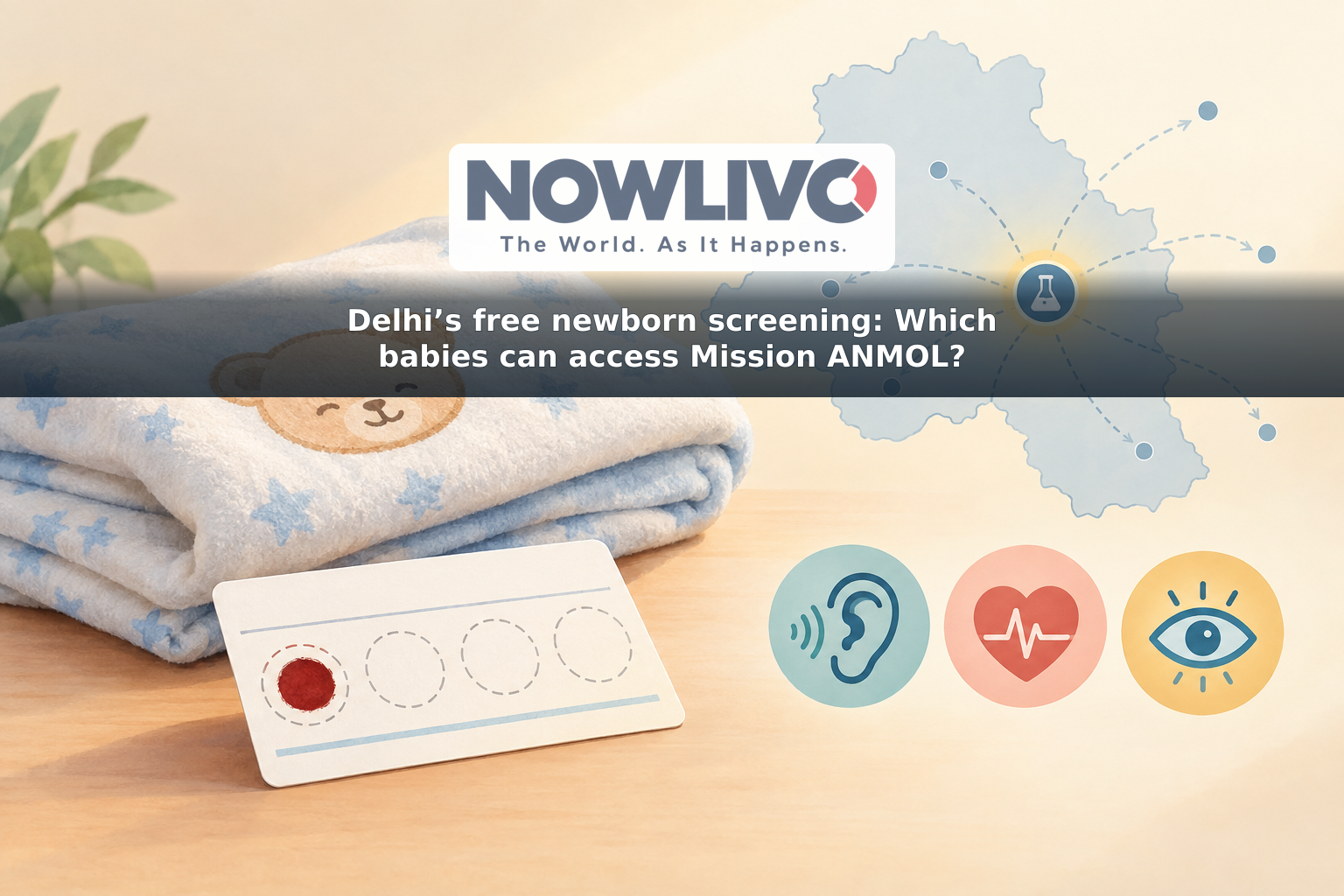
The government describes ANMOL as a free package of 56 types of newborn tests or screening checks, with a blood sample used for laboratory screening. Among the conditions identified in descriptions of the programme are congenital hypothyroidism, G6PD deficiency and congenital adrenal hyperplasia. These involve, respectively, thyroid hormone production, an enzyme affecting red blood cells and adrenal hormone production. The broader programme also addresses conditions detectable through other newborn assessments, including congenital heart problems, hearing impairment and eye conditions.
The distinction matters: a drop of blood cannot, by itself, stand in for a hearing check, an eye examination or assessment for a heart defect. Nor should the figure of 56 be read as a promise that one test diagnoses 56 genetic diseases. The publicly available government budget summary describes 56 types of free tests, but does not provide a family-facing, itemised panel explaining which checks are performed at each facility. Parents who need to know whether a particular condition is covered should ask the baby’s clinician or the screening team directly.
Screening looks for babies who may need further evaluation; it is not a final diagnosis. An unusual result needs prompt discussion with a clinician and, where appropriate, a confirmatory test. A result within the screening range does not rule out every genetic or congenital condition. Families should raise symptoms or a known family history with their baby’s doctor even if screening has been completed.
What should parents do at the hospital?
Before delivery, or as soon as possible after birth, ask the maternity or newborn-care team whether the hospital participates in Mission ANMOL. Ask specifically which samples and checks will be taken, whether they are free under the programme, and whether the baby needs an appointment or referral. If the hospital does not offer collection, ask the treating clinician about access through Lok Nayak Hospital rather than assuming a walk-in test is available.
Before discharge, check whether the baby’s sample was collected, which hearing, heart and eye checks were done separately, and who will receive the results. Give the hospital a working contact number, request a copy of the screening record and ask when to follow up if no result arrives. If a repeat sample or specialist assessment is requested, arrange it with the baby’s clinician rather than waiting for a routine visit.
Families seeking information about access at Lok Nayak Hospital can contact its main number, 011-23236000. The hospital is on Jawaharlal Nehru Marg, near Delhi Gate. Staff can advise on current collection or referral arrangements; the published programme information does not establish a separate online application process or guarantee direct testing for every walk-in newborn.
Delhi proposed ₹25 crore for ANMOL in its 2026–27 budget and set an annual screening goal of about 250,000 newborns. Those are a funding provision and a target, not evidence that every Delhi birth facility has completed the rollout. For parents, the immediate step is to confirm their own hospital’s participation and a clear route for receiving and acting on the baby’s results.