
2026 Nobel Medicine Prize: Who won, and how does optogenetics work?
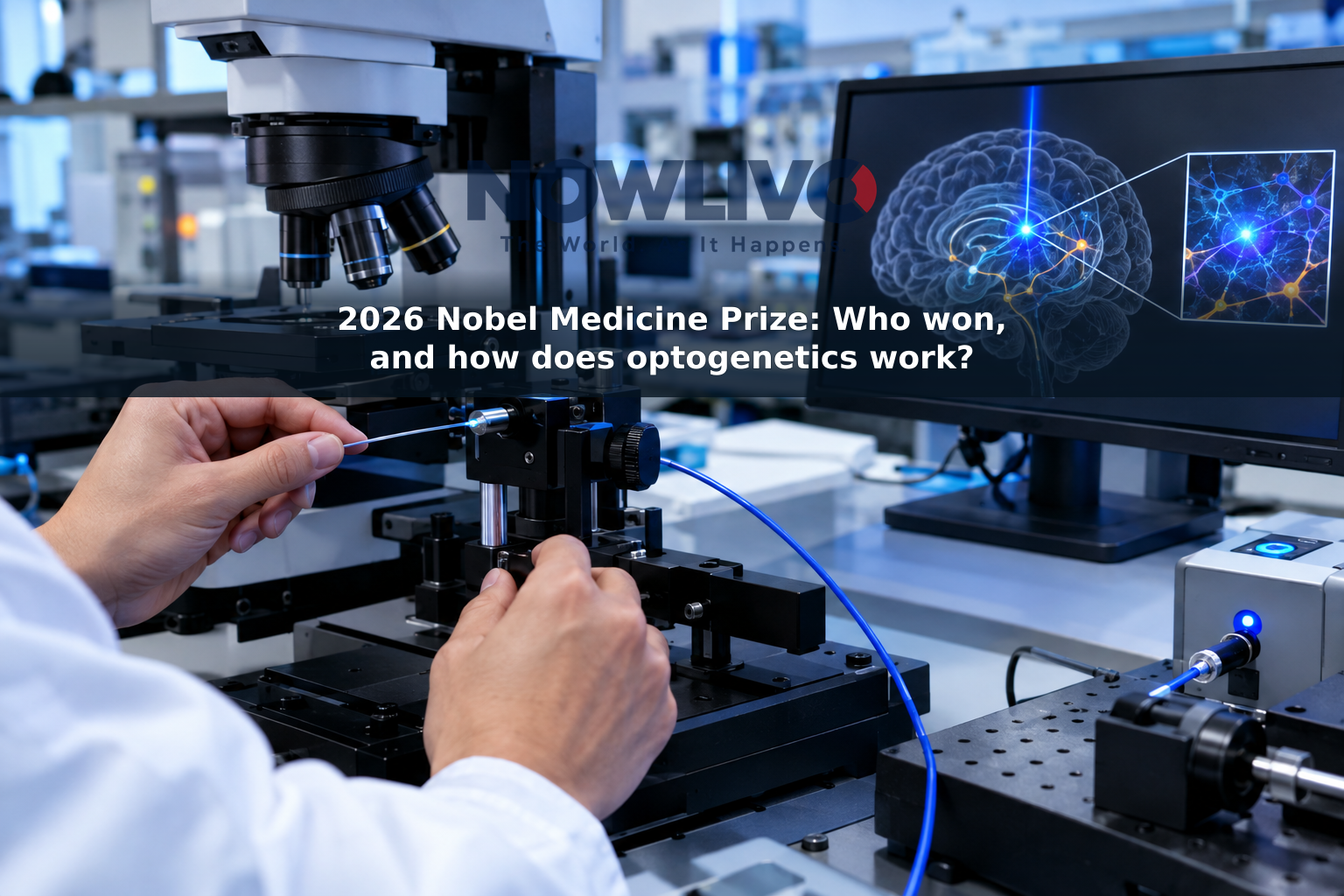
Karl Deisseroth, Peter Hegemann and Georg Nagel won the 2026 Nobel Prize in Physiology or Medicine for work behind optogenetics, the Nobel Assembly announced on October 5. The method lets researchers make selected nerve cells respond to light, then switch their activity on or off during an experiment. Its importance lies in helping scientists test what particular cells do—not in offering a ready-made treatment for brain disorders.
What is optogenetics?
Optogenetics combines genetic methods with light. Researchers equip a chosen group of cells with a light-sensitive protein, then illuminate those cells to change their activity. In neuroscience experiments, that can mean triggering a nerve signal or suppressing one at a precisely chosen moment.
The protein is essential. Ordinary light shone on a brain does not give scientists a switch for individual nerve cells. First, the cells they want to study must be made sensitive to light. Researchers can target particular types of neurons through the genetic method they use; they then deliver light to the relevant area, sometimes through a thin optical fiber. The combination gives them much finer control over which cells respond than illumination alone would provide.
Different light-sensitive proteins can produce different effects. Some help activate neurons; others can inhibit their activity. Researchers choose a protein, a target group of cells and a pattern of light suited to the question they are testing. “On” and “off” are useful shorthand, but nerve cells operate in circuits, so changing one group’s activity can affect other connected cells too.
What did the three laureates contribute?
Hegemann and Nagel investigated a light-sensitive protein called channelrhodopsin in single-celled algae. When illuminated with blue light, the protein opens a channel that allows charged particles to cross the cell membrane. That movement can alter a cell’s electrical state—the feature that made the protein valuable for studying nerve cells.
Deisseroth and colleagues brought this principle into neuroscience. They introduced a channelrhodopsin gene into rodent neurons and showed that blue light could make those cells produce nerve signals. Subsequent work extended light-based control to experiments in living animals and developed ways to inhibit, as well as activate, selected neurons. Together, the discoveries turned a property of an algal protein into a widely used research method.
Why does controlling nerve cells matter?
Observing that a set of neurons becomes active during an action is not the same as showing that it helps cause the action. Optogenetics lets researchers intervene: they can change the activity of selected cells at a particular time and look for a resulting change in the animal’s behavior or bodily function. If switching a circuit on or off changes the outcome, that provides stronger evidence about the circuit’s role.
The timing is especially useful because nerve cells send signals rapidly. Researchers can apply pulses of light during a specific part of an experiment rather than relying only on a drug that may act more broadly or persist longer. The method has helped scientists investigate circuits involved in movement, memory, feelings and behavior, including questions relevant to neurological and psychiatric conditions.
That precision still has limits. A change in an animal’s behavior does not mean researchers have found a single cell responsible for a complex experience. Brain functions arise from interacting networks, and results must be interpreted in light of exactly which cells were targeted, where the light reached and what the experiment measured.
Does the Nobel mean a treatment is near?
No. The prize recognizes discoveries that transformed how researchers investigate living circuits. Laboratory findings can point toward possible medical approaches, but controlling genetically modified cells in an experiment is different from safely and reliably treating a person. Clinical applications would have to address how to target the right cells, deliver light, establish lasting benefit and evaluate risks.
Researchers are exploring medical uses, including experimental efforts involving vision, but the award should not be read as an announcement of a new therapy for brain disease. For now, optogenetics’ clearest achievement is the ability to ask a more direct question about the brain: what changes when a specific group of nerve cells is made active—or quiet—at a specific moment?