New Pentagon Files Describe Reported Black Triangle Sightings at US Site
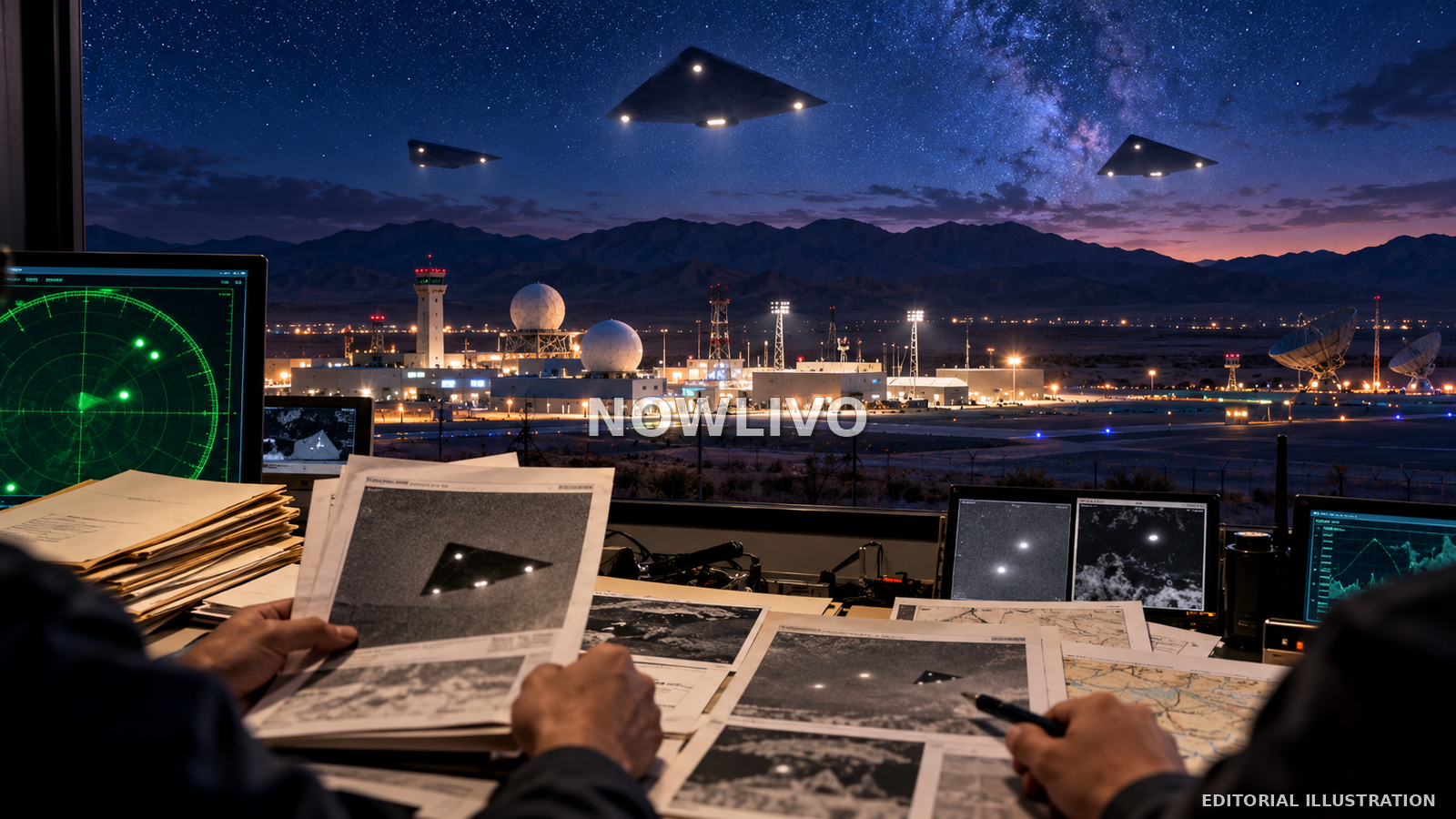
Newly released Pentagon records describe a report from earlier in 2026 in which two military observers said they saw a black triangular object above a sensitive site in the western United States. The observers described a shape resembling a delta-wing drone and estimated that it was moving at extraordinary speed before disappearing silently. The files have renewed public interest in unidentified aerial phenomena, but they do not establish that the object was extraterrestrial or identify its precise technology. The release contained fewer than 25 written documents and did not include video or photographs of the reported sighting, according to The Guardian. That limits how much independent analysis can be performed from the public material alone.
What the report says
The report describes two military observers who were experienced professionals with government backgrounds, although their identities and the exact location were withheld. They reportedly saw a black triangle estimated to be about 9 to 15 feet across and said it appeared to travel at roughly 1,800 miles per hour. Those figures are observations recorded in a report, not independently verified measurements from a controlled instrument. Without sensor records, range measurements or imagery, it is difficult to determine how precise the estimates were.
The observers said the object did not resemble conventional military aircraft and disappeared without an exhaust trail. Such descriptions help explain why the event was logged as unusual, but they do not determine what the object was. An investigation would compare the account with radar data, known aircraft activity, weather, sensor performance and other records from the time and location. A witness report may be important evidence, but a full identification usually requires more than a description of what appeared in the sky.
Unidentified does not mean extraterrestrial
UFO and UAP terms refer to something that has not been identified from the available information. They do not mean that an object came from another planet. The Pentagon’s release concerns a report that has not been publicly resolved, which is different from a verified claim about alien technology. The central issue is what the available evidence can establish, not which explanation attracts the most attention.
Objects can appear unusual because of distance, perspective, lighting, sensor artefacts, classified aircraft, drones or incomplete information. Some reports may remain unexplained because evidence is missing or data are not sufficient to reach a conclusion. The responsible approach is to describe the observation and its limitations rather than jump from uncertainty to a dramatic explanation. A lack of an answer is a real information gap, but it is not evidence for any one extraordinary explanation by itself.
What evidence was released
The report included nine nearly identical images of a canyon with small triangular shapes superimposed to illustrate the object’s movement. UFO historian Greg Eghigian criticised the images as providing little substantive evidence. The documents did not include video or photographs of the object itself, limiting the ability of outsiders to examine the sighting visually. Illustrations can explain how witnesses remember a sequence, but they are not equivalent to independently recorded imagery of the event.
A useful record would ideally specify the time, viewing angle, duration, sensor data and other observations that allow analysts to test alternative explanations. If the underlying report relies mainly on visual impressions, the public should know that limitation. Missing data do not prove that the witnesses invented the event; they limit the conclusions others can responsibly draw. The difference is important when reporting an unresolved sighting involving military personnel and a sensitive facility.
Why the location was withheld
The site was described as sensitive and the observers’ identities were not disclosed. Governments may withhold location information when a report involves a facility with security relevance, operational procedures or sensitive equipment. That can protect legitimate security interests, but it also limits independent assessment by journalists, scientists and the public. Without a location or detailed sensor information, analysts cannot readily compare the observation with aircraft routes, weather or other events at the same time.
A balance is possible: officials can publish enough technical information to explain the reasoning without naming a location or revealing operational details that could compromise security. A report might, for example, provide the types of sensors used, the time window, uncertainty ranges and whether other aircraft were in the area. Those details would allow more rigorous evaluation than a set of illustrative images alone. Transparency is most useful when it permits real analysis while protecting information that genuinely needs to remain restricted.
The administration’s disclosure effort
President Donald Trump announced in February that the government would release more previously classified records about UFOs. The latest disclosure was part of that broader effort. The release may provide researchers with material that was not publicly available, but the small number of documents and lack of original imagery have limited its evidentiary value in this case. The act of releasing a document is a transparency measure; it does not automatically resolve what the document describes.
Public-record releases can serve multiple goals: transparency, historical documentation, reassurance that reports are reviewed and scrutiny of how government agencies have handled unusual sightings. The value depends on whether records include enough context to support analysis. Repeated release of summaries without underlying data may generate attention without resolving the most important questions. A useful disclosure should help researchers understand what was observed, what evidence was collected and why the government reached a particular assessment.
How analysts would test the sighting
An assessment would compare witnesses’ observations with radar, satellite tracking if available, flight schedules, weather, camera systems and the performance of any sensors used. Investigators would also consider whether estimated speed and size are reliable, since both can be difficult to judge visually without reference points. If other military units recorded an object at the same time, those records might help identify whether the sighting corresponded to a known aircraft or an event already under investigation.
The absence of video or independent sensor records does not prove that the witnesses’ account is false. It means that others have fewer ways to test it. Witness testimony is useful, especially from trained observers, but the strongest identification usually emerges when multiple independent sources point toward the same conclusion. If the evidence remains incomplete, a report may correctly stay unresolved rather than offering a confident answer unsupported by the record.
What happens next
Further records, technical data or a statement from the relevant agency could change the assessment. The initial release does not resolve the reported sighting, and no evidence cited in the public summary establishes an extraterrestrial explanation. Future disclosures will be most useful if they include original records and technical context that allow qualified analysts to compare the witness report with other observations.
For now, the story is a report of an unusual observation documented by the Pentagon, with substantial gaps that prevent independent identification. The key questions are what the observers saw, what other data exist and whether the government will provide enough information for analysts to evaluate competing explanations. An unresolved report can remain newsworthy without being framed as proof of a sensational conclusion.