Agnikul Secures ₹200 Crore Push for Reusable Agnibaan Rocket
India has placed a substantial public-sector bet on reusable rocket technology, with the Technology Development Board signing an agreement to provide ₹200 crore in financial support to Chennai-based Agnikul Cosmos. Announced on September 25, 2026, the backing will support the development of Agnibaan RLV, a proposed fully reusable launch vehicle intended to make access to orbit more frequent and economical.

The Technology Development Board, which operates under the Department of Science and Technology, will provide the support through the government’s Research, Development and Innovation Fund. The financing will take the form of optionally convertible debentures, an instrument that begins as debt but may be converted into equity under agreed conditions.
That structure makes the agreement different from a conventional research grant. It gives the government a way to finance a high-risk technology programme while retaining the possibility of participating in the company’s future value. For Agnikul, it offers long-term capital for engineering work that may require years of testing before it generates dependable commercial revenue.
The goal: recovering more than the booster
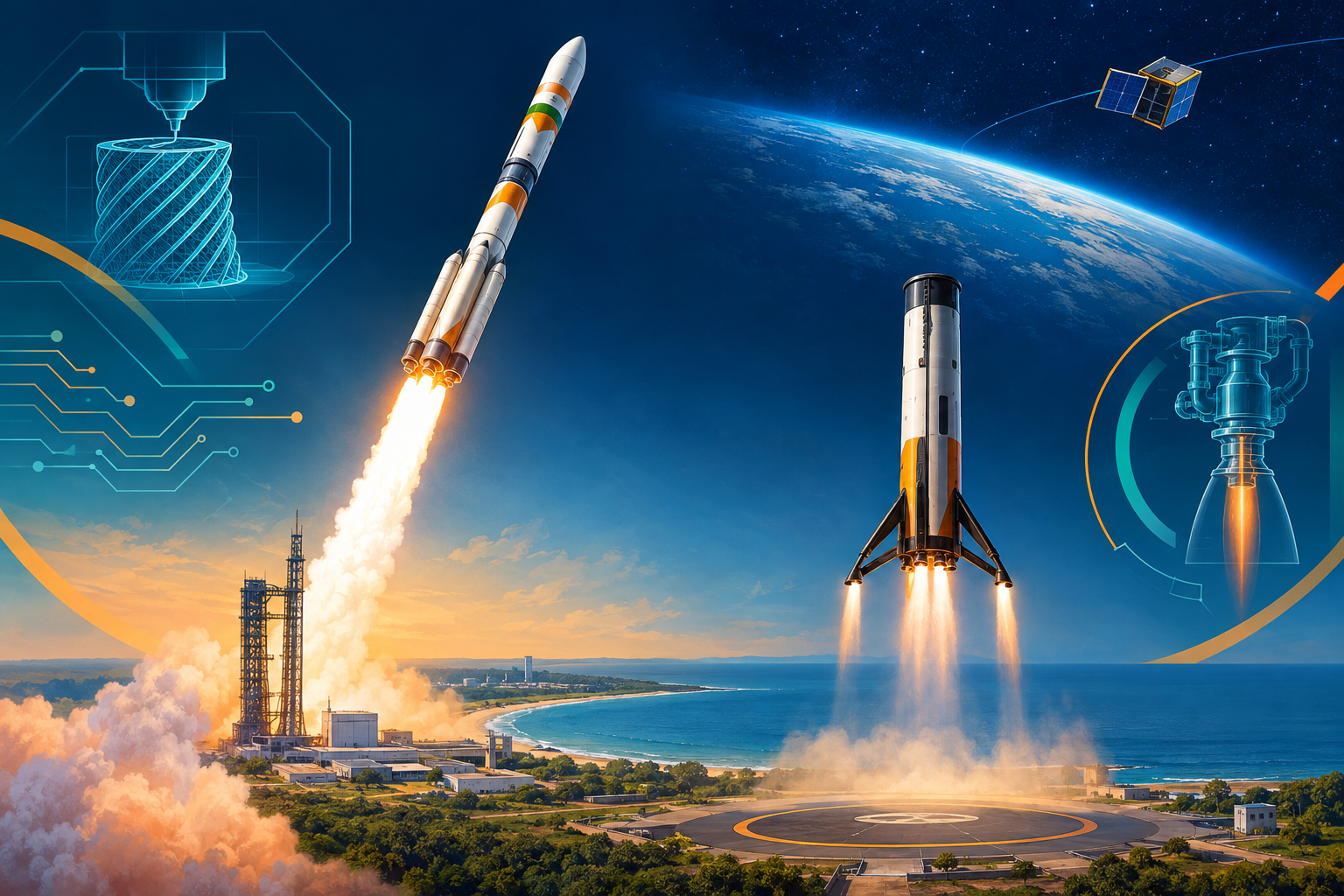
Most reusable rocket programmes initially focus on recovering the first stage, which provides the thrust needed during the opening phase of flight. Agnikul’s stated objective is more ambitious: to develop an architecture in which the wider launch system, including the upper stage, can be recovered and used again.
The proposed design combines a lightweight upper stage, accurate orbital-insertion systems and semi-cryogenic liquid propulsion. Engines capable of deep throttling and restarting will be particularly important. A rocket descending towards a recovery point must reduce and regulate its thrust precisely, while restarting an engine after ascent introduces additional demands involving ignition, propellant management and reliability.
The programme also covers the interconnected systems needed for ascent, guidance, orbital operations, controlled descent and recovery. Reusability is therefore not simply a matter of making a rocket physically strong enough to fly twice. The vehicle must survive demanding thermal and mechanical conditions, return safely and undergo inspection and preparation without erasing the economic benefits of reuse.
The project aims to move the relevant technology from Technology Readiness Level 4 or above towards Level 8. In practical terms, the target is to advance beyond laboratory and subsystem validation towards an integrated system that has been extensively tested and is approaching operational readiness. It does not mean a fully reusable Agnibaan is already available; significant development and flight validation remain necessary.
How Agnibaan provides the foundation
Agnibaan is Agnikul’s configurable launch-vehicle platform for small satellites. Its modular approach is designed to match a rocket more closely to the mass and orbital requirements of an individual mission, offering an alternative to satellites waiting for space on larger rideshare launches.
The company demonstrated important elements of its technology with the Agnibaan SOrTeD suborbital mission on May 30, 2024. That vehicle flew from Dhanush, Agnikul’s private launchpad at Sriharikota, using a single-piece 3D-printed semi-cryogenic engine. The flight generated data for the company’s planned orbital vehicle and demonstrated its ability to integrate propulsion, avionics, launch infrastructure and mission operations.
Agnikul’s Agnilet engine is central to that strategy. Producing an engine as a single 3D-printed component can reduce the number of joints and individually manufactured parts while potentially shortening production cycles. For a reusable launcher, however, rapid manufacturing must be matched by repeatable engine performance across multiple burns and flights.
Why the funding matters for private space companies
The agreement could carry significance beyond one rocket developer. Space-launch businesses require unusually large investments before reaching regular operations, while technical setbacks can create long delays. Conventional investors may hesitate to finance years of testing when the route to revenue remains uncertain.
Public financing can help bridge that gap between a promising prototype and a commercially deployable system. If the Agnibaan RLV programme meets its milestones, it could strengthen domestic expertise in reusable propulsion, precision guidance, advanced manufacturing, recovery operations and launch-site infrastructure. Suppliers working on valves, electronics, materials, sensors and testing equipment could also benefit.
Lower launch and manufacturing costs would improve the economics of dedicated missions for small satellites, although the eventual savings will depend on recovery rates, refurbishment requirements, reliability and launch demand. Higher flight frequency could give Indian satellite startups more options while making domestic launch providers more competitive internationally.
The larger test will be execution. Reusable orbital vehicles rank among the most difficult engineering systems ever attempted, and public funding cannot remove the technical risk. But the scale and structure of this agreement indicate that India is prepared to support private companies not only as suppliers, but as developers of original, strategically important space platforms.