India Launches Tarang Shakti 2026 Multinational Air Exercise in Jodhpur
The Indian Air Force on Saturday, September 26, launched the second edition of Tarang Shakti, its flagship multinational air exercise, at Air Force Station Jodhpur in Rajasthan. The exercise will continue through October 12, giving Indian and foreign personnel 17 days to plan and conduct demanding missions in a shared operational environment.

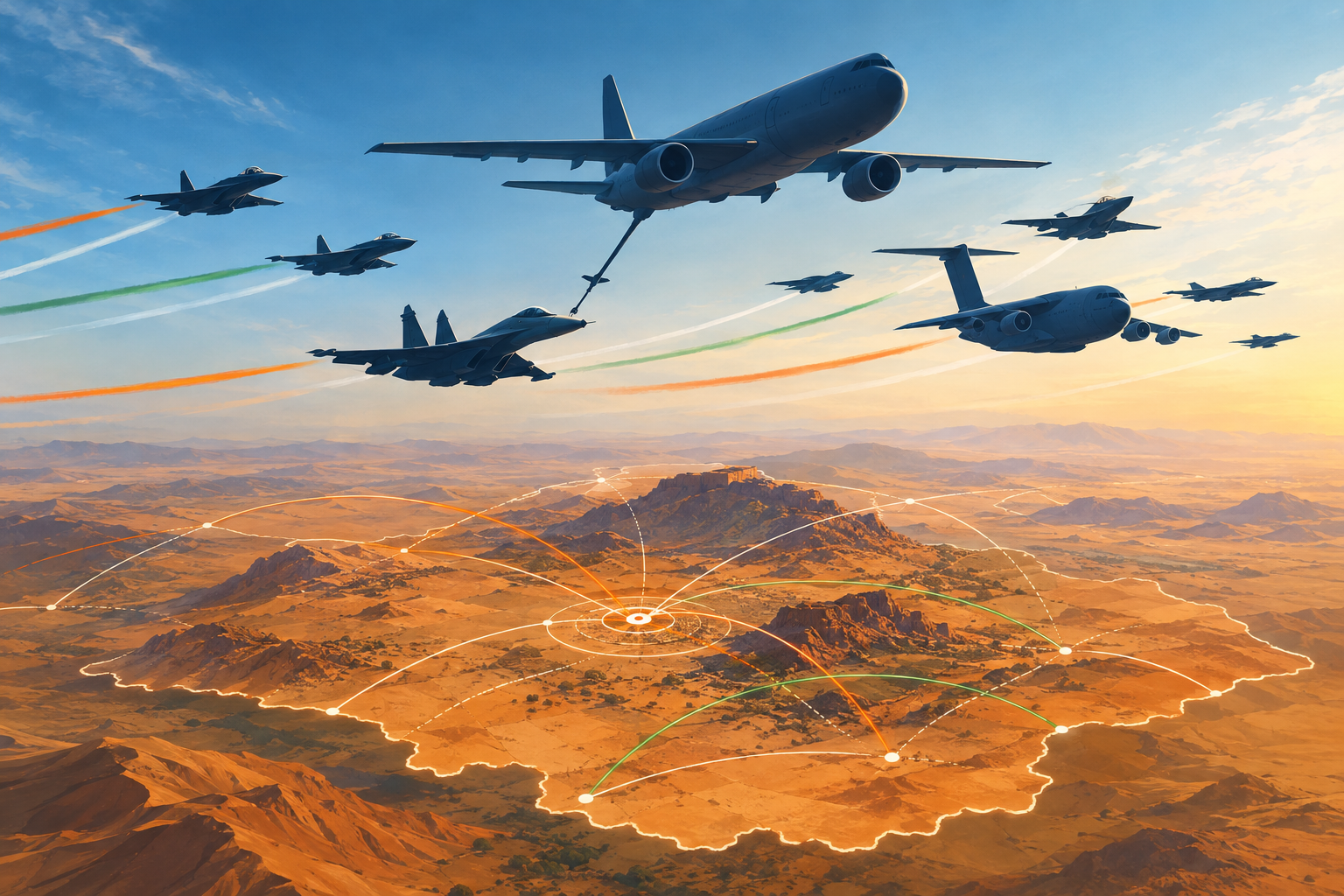
Training will be centred on Jodhpur and adjoining air bases in western Rajasthan. The region provides access to extensive airspace suited to large formations, simulated combat operations and missions involving fighters, transport aircraft, tankers and other specialised platforms.
Which countries are participating?
India is hosting flying contingents from eight foreign countries: Australia, Bangladesh, France, Germany, Greece, Sri Lanka, the United Arab Emirates and the United States. A further 32 nations are expected to attend in an observer capacity, broadening the exercise’s diplomatic and professional reach beyond the countries deploying aircraft.
The participating fleet brings together aircraft with different roles, capabilities and operating concepts. Prominent foreign platforms include American F-35 fighters, French Rafales, UAE F-16s and a Bangladeshi C-130J transport aircraft. India is fielding a cross-section of its combat fleet, including Rafale, Su-30MKI, Tejas, Mirage 2000, MiG-29 and Jaguar aircraft, supported by transport, surveillance and air-to-air refuelling assets.
The appearance of the F-35 is particularly significant because it gives Indian personnel an opportunity to train alongside a fifth-generation stealth fighter during tactical missions conducted from an Indian base. The wider value, however, comes from integrating numerous aircraft types, crews and command systems rather than from any single platform.
What will the air forces practise?
The Indian Air Force says Tarang Shakti 2026 is designed to expose participants to the planning and execution of multinational joint combat operations in a realistic contemporary battlespace. The aim is to develop workable tactical solutions while improving the ability of different air forces to communicate, coordinate and operate together.
Scheduled mission sets cover counter-air operations, air defence, reconnaissance, airlift, air-to-air refuelling and complex composite missions. Such scenarios require fighter crews, transport units, controllers, mission planners and support teams to synchronise their work despite differences in procedures, equipment and operational experience.
Vice Chief of the Air Staff Air Marshal Ashutosh Dixit described the exercise as an opportunity for participants to learn from one another, operate together and prepare for future air-warfare challenges. That emphasis reflects the changing character of conflict, in which aircraft increasingly work as part of networks involving sensors, electronic warfare, unmanned systems, ground-based air defence and space-enabled capabilities.
Why Tarang Shakti matters for India
For India, the exercise represents a shift from relying mainly on separate bilateral drills towards training with several partner air forces at the same time. Bilateral exercises remain useful for developing close operational relationships, but multinational operations introduce added complexity. Crews must manage crowded airspace, varied aircraft performance, different command structures and restrictions on sharing sensitive information.
Practising those tasks in peacetime can improve interoperability during humanitarian relief, evacuation operations, disaster response, maritime security missions and other contingencies in which multiple countries may need to act together. It also allows India to compare operational practices, test its planning processes and identify gaps in communications, logistics and mission coordination.
Tarang Shakti also serves as a platform for air-power diplomacy. Hosting advanced foreign aircraft demonstrates India’s ability to organise and sustain a large international aviation exercise, while the presence of countries from South Asia, Europe, the Gulf and the Indo-Pacific strengthens military-to-military contacts across several regions.
Regional security significance
The exercise is taking place as Asian air forces place greater emphasis on long-range precision weapons, integrated air and missile defence, electronic warfare and information superiority. Training with a diverse group of partners helps India study how modern systems can be combined while preserving its own operational independence.
Tarang Shakti is not publicly presented as a drill against a particular country. Its strategic message is nevertheless clear: India wants an air force capable of working effectively with multiple partners, absorbing lessons from different combat doctrines and responding to fast-changing security conditions. By bringing flying contingents and observers together through October 12, the exercise strengthens both practical cooperation and the relationships needed to support regional stability.