
Why India’s 15,800 El Niño Heat-Death Forecast Is a Warning, Not a Count
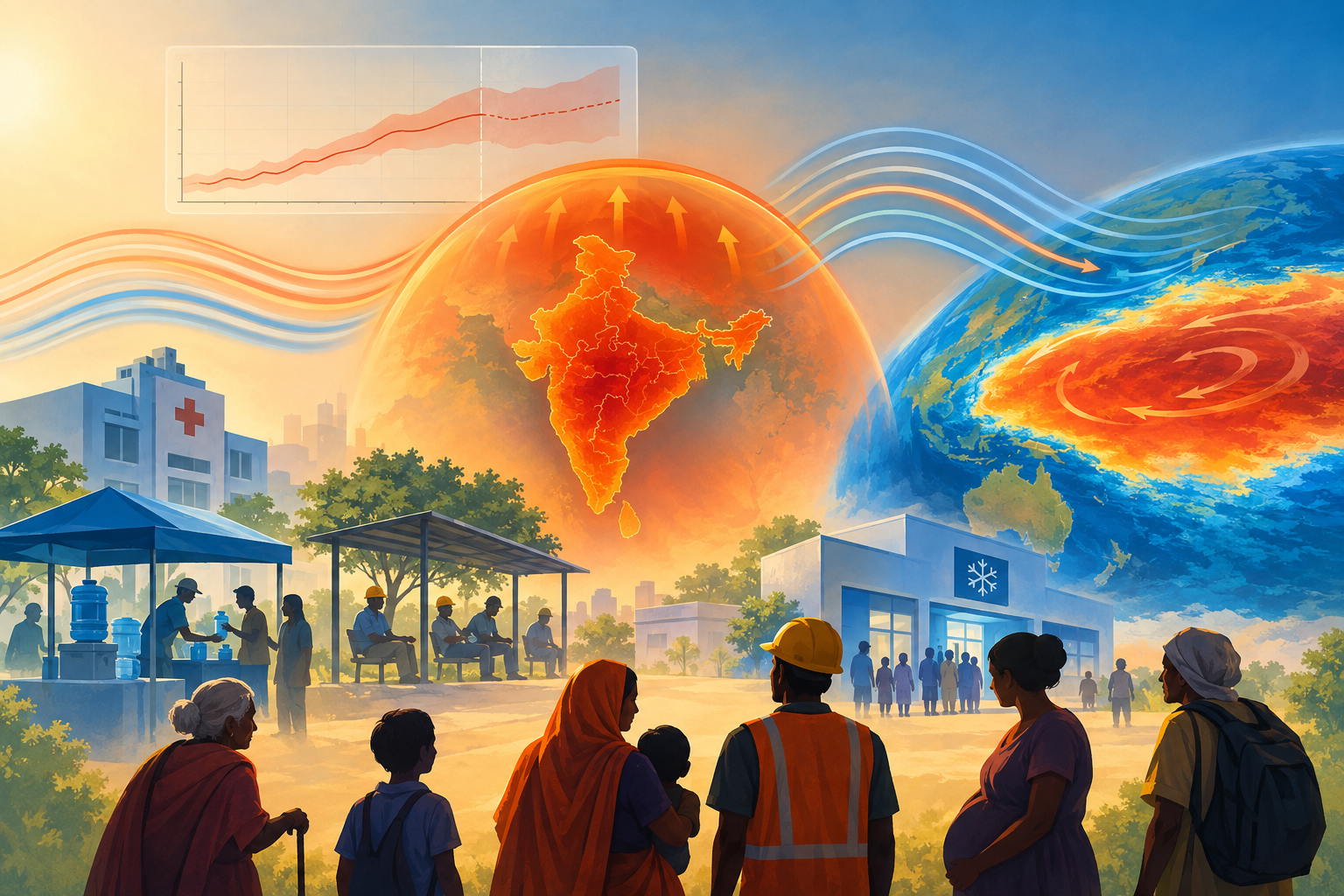
India could experience approximately 15,800 additional heat-related deaths between September 2026 and February 2027 under unusually warm conditions associated with the developing “super El Niño,” according to a Climate Impact Lab forecast.

The number must be interpreted carefully. It is a forecast of excess mortality compared with an average year, not a confirmed death count, a tally of identified heatstroke victims or a prediction that exactly 15,800 death certificates will mention heat. It represents deaths that a statistical model associates with forecast temperatures above the seasonal norm.
How the forecast was produced
The analysis combines two main components. The first is a six-month seasonal temperature forecast from the European Centre for Medium-Range Weather Forecasts’ SEAS5 system. Rather than relying on a single weather simulation, the system uses a 51-member ensemble representing different plausible temperature outcomes.
The second component is a set of estimated relationships between temperature and mortality across 24,378 regions worldwide. These relationships account for differences in local climate, vulnerability and capacity to adapt. A very hot day does not produce the same health effect everywhere: income, access to cooling, housing quality, health services and previous experience with high temperatures can change the risk.
Researchers applied those mortality relationships to the forecast temperature anomalies and compared the result with the corresponding months in the 1996-2025 average. The 30-year reference period means the forecast is estimating how many more deaths could occur than would normally be expected from September through February.
The wider global scenario assumes population-weighted land temperatures will be about 1.2 degrees Celsius above normal over the coming months, producing considerably more extremely hot days. “Super El Niño” is an informal description for an exceptionally strong event rather than a separate official category.
What the uncertainty range means
The India estimate is 15,800, plus or minus approximately 1,600 deaths. Expressed as a range, that is roughly 14,200 to 17,400. The stated interval incorporates uncertainty from the seasonal forecast ensemble and from the estimated relationship between temperature and mortality.
It should not be treated as a complete boundary around every possible outcome. Seasonal forecasts can change, local weather may diverge from country-level patterns, and public behaviour or government action can alter exposure. Power reliability, healthcare capacity, outdoor work schedules, water access and emergency measures could all affect the eventual toll.
The underlying temperature-mortality research has undergone peer review, but the complete method used for this specific short-term El Niño forecast has not yet been published in a peer-reviewed journal. The research team has said it intends to update the projections as the event develops.
Where India’s exposure may be greatest
The model places India fourth among countries with the largest projected totals during the six-month window. About 7,400 of the estimated additional deaths are forecast for December 2026 through February 2027.
The seasonal pattern is not uniform across India. Northern winters are generally cool enough that modest abnormal warmth may produce a smaller heat-mortality signal during these months. Southern India remains warm through winter, so additional warming can push already elevated temperatures further into harmful territory. The forecast therefore indicates a sharper winter increase in southern regions, without identifying a definitive state-by-state death count.
The February endpoint is also important. It reflects the limit of the seasonal forecast used in the analysis, not the expected end of India’s risk. If abnormal warmth persists, exposure in northern and central India could rise as the country moves toward the hotter pre-monsoon and summer periods.
Why official counts may look different
Heat often contributes to death indirectly by worsening cardiovascular, respiratory, kidney and other medical conditions. Such deaths may never be formally recorded as heat-related. Excess-mortality models attempt to capture this broader effect, which is one reason their estimates can be much higher than administrative heatstroke totals.
That does not make every statistically estimated death individually attributable to El Niño. The forecast describes population-level risk associated with projected temperatures, not a list of medically confirmed cases or a precise causal accounting of the climate event.
What public-health agencies can do now
The forecast’s practical value lies in the months of warning it provides. Health departments can strengthen surveillance, prepare hospitals and ambulances for rapid cooling, secure water and oral rehydration supplies, and map communities with limited access to cooling.
Local authorities can expand heat alerts, shaded rest areas, hydration stations and accessible cooling spaces. Employers should adjust hours, rest breaks and workloads for outdoor and manual workers. Outreach should prioritise older adults, infants, pregnant people, those with chronic illness, people living alone and households in poorly ventilated homes.
The figure of 15,800 is therefore best understood as a preventable-risk estimate. It is neither a confirmed tragedy nor a fixed outcome. Its central message is that unusually warm conditions could create a serious public-health burden—and that preparation undertaken before the hottest periods could reduce it.