Did China’s Global Times Defend India Against Elon Musk? What’s Verified About Starlink and Chinese EVs
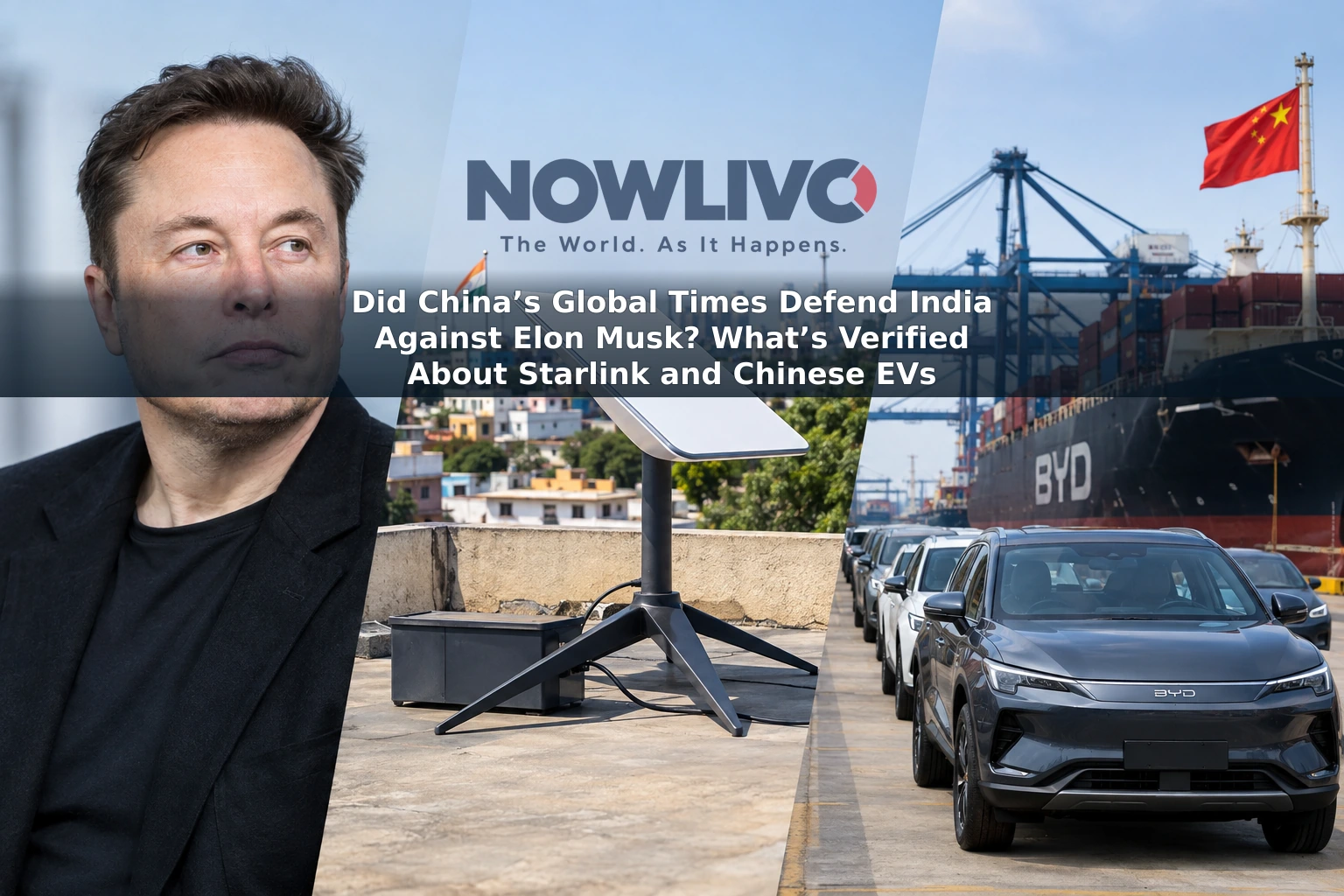
Did China’s Global Times defend India against Elon Musk over Starlink? The alleged response—asking whether Musk is the “real boss” of the United States because of restrictions on Chinese electric cars—could not be verified as a Global Times statement. The dispute it refers to is real: Musk questioned Mukesh Ambani’s influence after complaining that Starlink had not been allowed to launch in India. But his suggestion that Starlink has received no licence leaves out an important fact: India has already granted the company a telecom licence.
What did Elon Musk say about Ambani and Starlink?
On October 8, 2026, Musk asked on X whether Ambani was the “real boss of India.” He also said Starlink had spent five years meeting Indian government requirements and questioned why it still lacked permission to operate. In an earlier post, Musk alleged that unnamed powerful business interests were blocking Starlink to protect their position in India’s telecom market. He did not provide evidence that Ambani or his companies had prevented a government approval.
The distinction between a licence and permission to begin commercial service matters here. India’s communications ministry stated in January 2026 that Starlink Satellite Communications, Jio Satellite Communications and OneWeb India Communications had each received a unified telecom licence authorising satellite services. Starlink has not yet launched its commercial internet service in India because further steps remain.
Why has Starlink not launched in India?
In a statement issued on October 8, India’s communications ministry said security assessments were under way for all three licensed satellite operators. Once an operator completes that process, it can proceed to seek an assignment of spectrum—the radio frequencies needed to provide service. The ministry said the three companies were at broadly the same regulatory stage and rejected the suggestion that its approval process was discriminatory.
That is the government’s account of the delay, not proof that every question about the process has been settled. It does, however, contradict the idea that Starlink alone has been denied an initial licence while its rivals are free to operate. Reliance Jio and Bharti Airtel also announced agreements in 2025 to help distribute Starlink services in India, subject to regulatory approval, despite their competition with Musk’s company.
What about the Global Times claim and the 100% tariff?
The reported Global Times comeback draws a comparison with Chinese electric vehicles in the US. The tariff figure has a factual basis: in 2024, the US raised its additional tariff on electric vehicles from China to 100%. The US has also adopted separate restrictions concerning certain connected-vehicle technology linked to China and Russia.
Those measures do not establish that Tesla or Musk personally caused the US policy, or that every Chinese carmaker was individually refused an operating licence. An import tariff on cars and a security-and-spectrum approval process for satellite internet are also different kinds of regulation. The comparison may be a political argument, but it does not explain why Starlink’s remaining Indian approvals are pending.
No authenticated Global Times article or post was found confirming that the publication made the “real boss of the US” remark. It should not be presented as the newspaper’s response without an identifiable original statement. What is established is narrower: Musk challenged India’s treatment of Starlink, India rejected his allegation of discrimination, and Starlink remains unable to begin commercial service while further approvals are pending.