NASA Balloon Flight Puts Student Experiments and Camera Technology to the Test
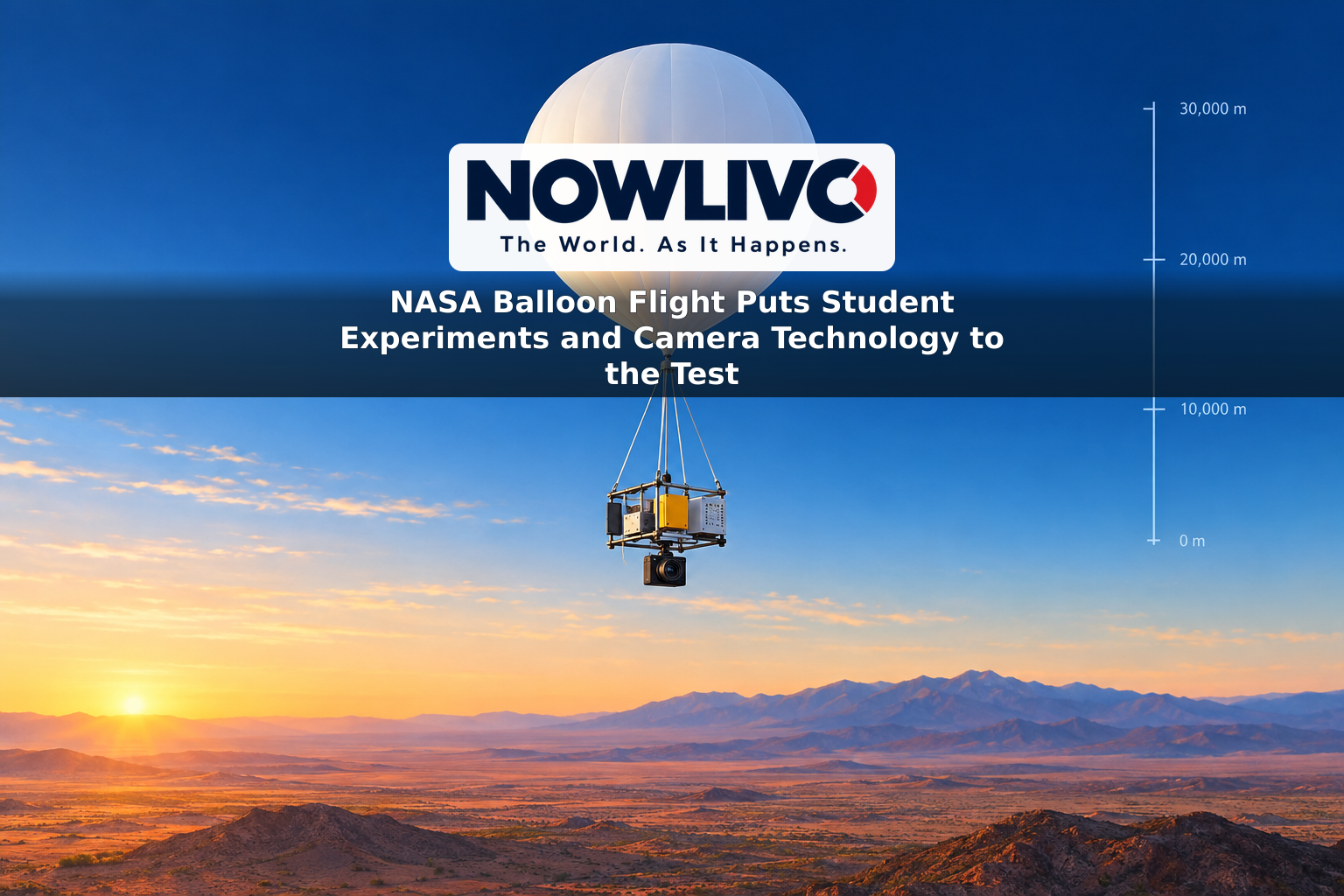
A balloon rising over Fort Sumner, New Mexico, on September 28 carried more than a test rig. NASA’s Mullenax Test Flight also gave university researchers and student builders a chance to fly projects high above Earth, alongside experimental smart-camera technology.
The balloon launched at 7:57 a.m. Mountain Daylight Time and reached a float altitude of about 105,900 feet—roughly 20 miles above the ground. Its flight lasted 10 hours and 14 minutes. NASA counted it as the fifth balloon mission to launch in its 2026 Fort Sumner fall campaign.
One flight, several jobs
The Mullenax mission was designed first as a practical test and training opportunity. Meteorology and rigging personnel used it to work with the procedures and hardware involved in a scientific balloon flight. Forecasting conditions and preparing equipment matter when a large balloon must lift an instrument-bearing structure safely into the air and keep it aloft long enough to gather useful information.
The flight also made room for science. NASA said the payload included university and student-built projects, as well as experimental smart-camera technology. That combination is an advantage of a test flight: equipment can be tried in the stratosphere while the balloon team carries out its own operational work.
NASA has not identified the individual university or student projects aboard Mullenax in its flight update. It has also not specified what the smart-camera system was intended to recognize or how it performed. The confirmed result so far is that the equipment flew; the flight announcement does not establish that each experiment met its objectives.
Why fly experiments on a balloon?
A high-altitude balloon offers researchers access to conditions far above those encountered at ground level without requiring an orbital launch. Instruments can be exposed to the cold, low-pressure environment of the upper atmosphere, while engineering teams can see how their hardware behaves during an actual flight rather than relying only on laboratory tests. Depending on an experiment’s design, that may help its builders identify changes needed before another balloon mission or a more demanding application.
For students, the value extends beyond the time spent aloft. A working payload must be planned, built and prepared to operate within the limits of a shared flight. Once it has flown, its team can compare the information it collected with what it expected. Mullenax provided that opportunity to student builders, although NASA has not released enough detail to describe their individual research questions or results.
The balloons used for the Fort Sumner campaign are known as zero-pressure balloons. They have openings that allow lifting gas to escape as it expands during ascent, rather than allowing pressure inside the balloon to keep building. NASA generally uses this type for shorter domestic flights. Mullenax’s roughly 10-hour journey fits that role: it was a test flight, not a months-long expedition or a spacecraft entering orbit.
A separate student mission in the same campaign
Mullenax was not the campaign’s dedicated High-Altitude Student Platform flight. That mission, known as HASP, launched from Fort Sumner on September 2 and carried experiments developed by student teams. NASA said the 2026 campaign marked HASP’s 20th flight and that 17 student teams were participating this year. Those figures describe the student platform program, not the number of projects aboard Mullenax.
Keeping the flights distinct shows the range of opportunities within the fall campaign. HASP was organized around student payloads; Mullenax paired student and university work with crew training, hardware checks and a camera experiment. Other flights in the campaign have carried different science instruments and technology demonstrations.
The next step for the Mullenax projects is understanding what the hours aloft revealed. NASA’s reported altitude and duration show that the balloon provided a flight opportunity. Whether the camera technology and each university or student payload performed as intended will require information beyond the initial launch update.