
The Global AI Divide: AI Is Spreading Fast — But Not Equally
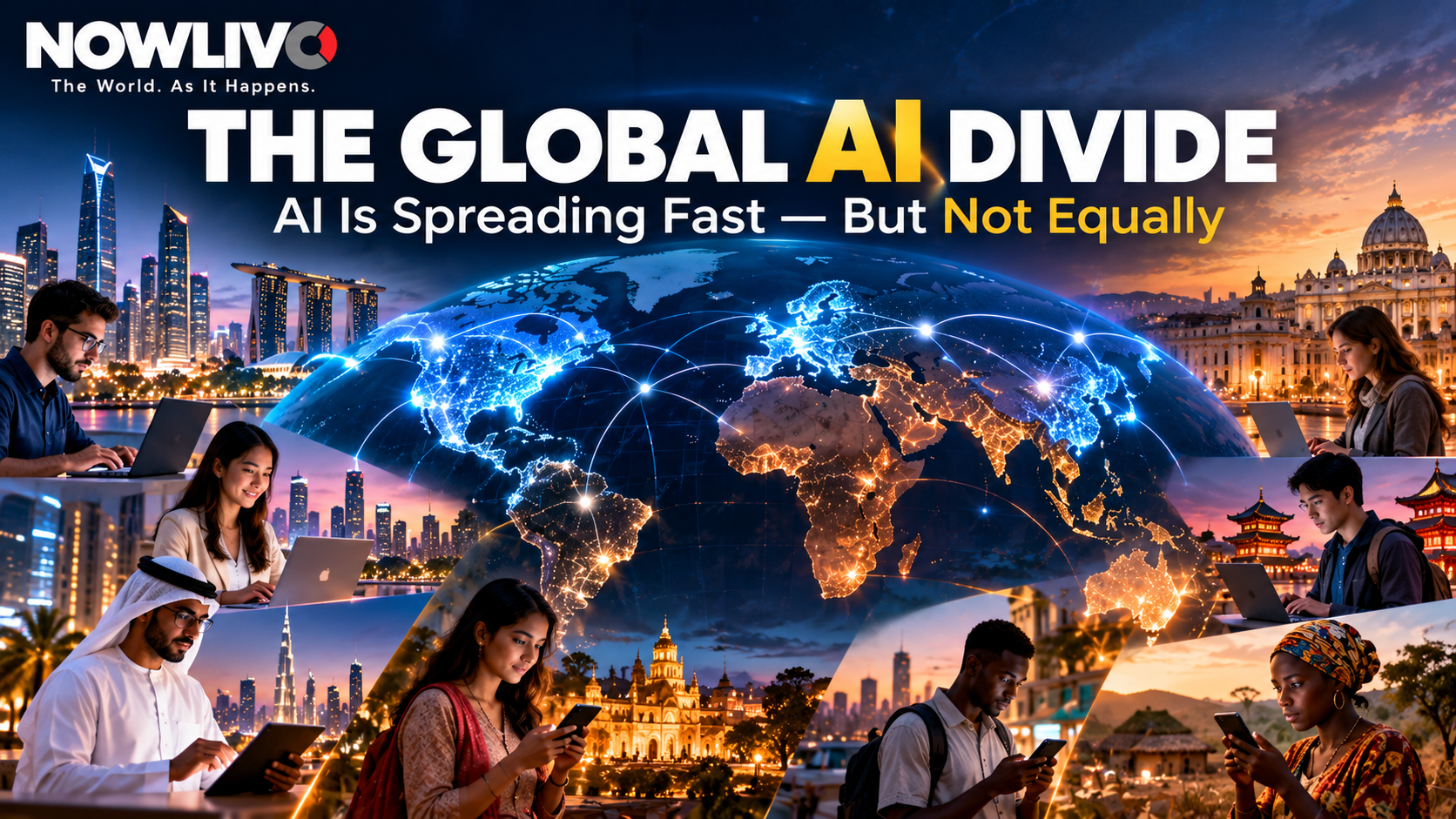
Artificial intelligence is becoming a global technology at remarkable speed.

It writes emails, translates languages, generates images, explains difficult concepts, helps programmers write software and gives millions of people an entirely new way to search for information.
But the AI revolution is not spreading evenly.
In June 2026, approximately 18.8% of the world’s working-age population was using generative AI, up from 17.8% during the first quarter of the year.
That means generative AI has already reached a significant share of working-age people worldwide.
Yet the global average conceals enormous differences.
In the world’s leading market, measured adoption has climbed above 70% of the working-age population. In several other highly connected economies, more than four in ten working-age people are already using generative AI.
Meanwhile, large parts of the world remain below 10%.
This is becoming one of the most important questions surrounding artificial intelligence:
What happens when access to a potentially transformative technology advances much faster in some societies than in others?
AI adoption is growing almost everywhere
The first important point is encouraging.
Generative AI isn’t expanding only in a handful of technology centers.
During the second quarter of 2026, measured adoption increased across almost every economy in a dataset covering 147 economies.
Global usage rose approximately one percentage point in a single quarter.
That may sound modest until the scale is considered.
An increase of one percentage point across the world’s working-age population represents tens of millions of additional people beginning to use generative-AI tools.
And adoption is no longer limited to people working directly in technology.
Students use AI to understand difficult subjects.
Office workers use it to summarize documents.
Small businesses use it to create marketing materials.
Programmers use it to generate and debug code.
Travelers use it to plan journeys.
Researchers use it to explore information.
Creators use it to generate text, images, audio and video.
AI is gradually moving from a specialized technology into a general digital tool.
But how quickly that transition happens depends heavily on where a person lives.
Some countries are adopting AI extraordinarily quickly
The differences at the top of the adoption table are striking.
In the United Arab Emirates, measured generative-AI use reached approximately 73.3% of the working-age population in June 2026.
Singapore followed at about 64.3%.
Ireland reached approximately 49.9%, France 49.6% and Norway 49.4%.
Spain stood at 45.1%, New Zealand at 44.1% and the United Kingdom at 43.7%.
The Netherlands and Qatar were both around 43.5%.
Australia and South Korea were slightly above 40%.
These numbers suggest that in some highly connected economies, generative AI is already transitioning toward mainstream usage.
The question is why.
There is no single explanation.
Internet access matters.
Education matters.
Digital skills matter.
Language support matters.
Income matters.
Availability of AI products matters.
Government digital infrastructure can matter.
The structure of a country’s economy can matter.
And increasingly, people’s willingness to experiment with new technology matters too.
AI adoption is therefore not simply a measure of technological sophistication.
It reflects an entire ecosystem surrounding the user.
The North-South AI gap is widening
The most consequential pattern is not which individual country ranks first.
It is the widening difference between broad groups of economies.
In June 2026, measured generative-AI adoption among the working-age population reached approximately 28.8% across the Global North, compared with 16.2% across the Global South.
Both groups are adopting AI.
But the higher-adoption group is moving faster.
That matters because technological advantages can compound.
A worker who begins using AI today has time to learn where it works, where it fails and how to incorporate it into everyday tasks.
A company that adopts AI early can redesign workflows around it.
A student with access to capable AI tutoring tools can experiment with them throughout an education.
An entrepreneur can use AI to reduce the cost of writing, programming, translation, design and research.
If those advantages accumulate for years, today’s adoption gap could eventually become something more consequential:
an AI capability gap.
The new digital divide is about more than internet access
For decades, policymakers discussed the digital divide primarily in terms of connectivity.
Who had internet access?
Who owned a computer?
Who could afford a smartphone?
Those questions still matter.
But AI introduces another layer.
Two people can both have internet-connected smartphones while having radically different access to artificial intelligence.
One may have fast broadband, a modern device, strong digital literacy, AI tools that work fluently in their language and the ability to pay for premium services.
Another may rely on expensive mobile data, an older phone and AI systems with weak support for the language they use every day.
Technically, both are online.
Practically, their ability to benefit from AI can be very different.
The AI divide is therefore not one divide.
It is several overlapping divides.
Connectivity remains the foundation
AI may feel like software, but it depends on physical infrastructure.
Users need reliable internet connectivity.
Cloud AI systems depend on enormous data centers.
Those data centers depend on electricity.
Networks must connect users to computing infrastructure quickly enough for AI services to feel useful.
This makes AI adoption closely connected to a much older infrastructure challenge.
Regions that still struggle with reliable electricity or affordable high-speed internet face an immediate disadvantage.
AI cannot become an everyday productivity tool if accessing it is slow, unreliable or expensive.
This is particularly important as AI systems become more multimodal.
Generating or analyzing text requires relatively little data from the user’s connection.
Images, audio, real-time voice and video can demand much more.
The more sophisticated AI becomes, the more important the infrastructure underneath it may become.
Language may be one of the biggest hidden barriers
The early generative-AI revolution was heavily centered on English.
That is changing rapidly.
Modern AI systems increasingly support dozens of languages, and improvements in multilingual capability are helping adoption spread into new markets.
But language support is not simply about translating individual words correctly.
A useful AI system needs to understand context.
Idioms.
Regional vocabulary.
Mixed-language conversations.
Cultural references.
Different writing systems.
Informal speech.
Technical terminology.
A model that performs brilliantly in one language may still produce weaker results in another.
That matters enormously in countries where hundreds of millions of people do not primarily communicate in English.
Improved multilingual AI can therefore unlock enormous populations of potential users.
Recent adoption patterns in several Asian markets already suggest that improvements in local-language capabilities can help accelerate usage.
The next billion AI users may not interact with AI primarily in English.
Education could become AI’s great equalizer—or another dividing line
One of the most interesting global patterns involves education.
In many developing economies, education and learning account for a particularly important share of AI usage.
That makes intuitive sense.
A capable AI system can explain algebra.
It can help someone practice another language.
It can simplify a difficult scientific concept.
It can generate practice questions.
It can help a student understand computer programming.
It can provide personalized explanations at almost any hour.
For a student with limited access to tutors or educational resources, that capability could be extraordinarily valuable.
But there is another possibility.
If students in wealthier communities have reliable internet, newer devices, premium AI tools and teachers trained to integrate them effectively—while other students do not—the technology could widen educational inequalities instead.
AI itself does not determine which outcome occurs.
Access does.
South Korea shows how quickly adoption can accelerate
National adoption patterns are not fixed.
South Korea provides a useful example.
During the second quarter of 2026, its measured generative-AI adoption increased by approximately 3.5 percentage points, reaching around 40.6% of the working-age population.
That was the largest absolute quarterly increase among the economies measured.
Rapid changes like this demonstrate why today’s AI map should not be viewed as permanent.
Countries can move quickly when infrastructure, useful products, language support and public adoption align.
Japan has also been accelerating.
Its measured usage increased by approximately 2.2 percentage points during the quarter, representing roughly 10% growth relative to its first-quarter level.
The lesson is important:
AI leadership isn’t determined solely by who adopted first.
The pace of diffusion matters too.
Smaller countries can move surprisingly fast
Another striking feature of the global AI map is that population size does not determine adoption leadership.
Some relatively small economies are among the world’s fastest adopters.
That makes AI different from many previous industrial technologies.
Building a massive automobile industry requires factories, supply chains and enormous capital expenditure.
Individuals can begin using generative AI almost immediately once capable services, connectivity and suitable devices are available.
A small country with excellent digital infrastructure and a highly connected population can therefore achieve extremely high adoption rates.
This gives smaller economies an opportunity to compete in areas where scale once provided a much greater advantage.
But using AI is not the same as creating AI.
That distinction is important.
Adoption and AI leadership are not the same thing
A country can have widespread AI usage without developing its own frontier models.
Building advanced AI systems requires enormous resources.
Specialized chips.
Data centers.
Electricity.
Researchers.
Engineers.
Capital.
Large datasets.
Cloud infrastructure.
A country may therefore become an enthusiastic consumer of AI while depending almost entirely on technology developed elsewhere.
This creates another dimension of the global AI divide.
There is a difference between:
using AI,
building applications with AI,
and
controlling the underlying AI infrastructure.
The countries leading each category may not be the same.
Over time, that could become strategically important.
Open models could change the geography of AI
One factor that could reduce some barriers is the growth of openly available AI models.
Organizations that can access adaptable models do not necessarily need to build a frontier AI system from the beginning.
They can customize existing technology.
That could help universities, startups and governments develop AI systems tailored to local needs.
Language is a particularly important example.
An adaptable model could potentially be improved using regional languages and specialized local information.
Agricultural applications could focus on local crops.
Educational tools could follow national curricula.
Government services could operate in multiple regional languages.
Healthcare-support systems could be designed around local conditions.
This doesn’t eliminate the cost of computing infrastructure.
But it can lower some barriers to participation.
Smartphones may determine how global AI really becomes
Much of the AI industry is still imagined through the laptop.
Globally, the smartphone may prove more important.
For billions of people, a phone is their primary computing device.
That means truly global AI needs to work well on mobile hardware and constrained networks.
Smaller models capable of running partly or entirely on a device could become particularly important.
On-device AI can reduce dependence on constant high-speed connectivity for some applications.
It can potentially improve privacy.
It can reduce latency.
And it may make useful AI available in places where cloud access is expensive or unreliable.
If the next phase of AI is designed primarily for powerful computers and premium subscriptions, global adoption could remain uneven.
If useful AI increasingly runs on affordable smartphones, the map could change dramatically.
Price matters more than the technology industry sometimes admits
Many of the world’s most capable AI services operate with a freemium model.
Basic access may be free.
More advanced capabilities require payment.
For a professional in a high-income economy, a monthly AI subscription might represent a relatively minor expense.
For someone earning much less, the identical subscription can represent a significant portion of disposable income.
That creates another layer of inequality.
The important divide may eventually be less about AI users versus non-users and more about the quality of AI available to each group.
One user may have access to basic capabilities.
Another may have sophisticated reasoning, advanced research tools, large context windows, professional coding systems and high-quality multimedia generation.
Both count as AI users.
Their capabilities are not equivalent.
Businesses face their own AI divide
The same pattern appears among companies.
Large corporations can invest in infrastructure, training, security and customized AI systems.
Small businesses often cannot.
Yet small businesses could also gain disproportionately from AI.
A small company may not be able to hire a full-time designer, translator, programmer, researcher or marketing specialist.
AI can provide partial access to some of those capabilities at dramatically lower cost.
That could increase productivity and help small firms compete.
But only if owners and employees know how to use the technology effectively.
This is why AI literacy may become as important as AI access.
Providing a tool is not the same as providing the skills required to benefit from it.
The real divide may eventually be about skills
As AI becomes widely available, access alone may stop being the primary differentiator.
Knowing how to use it could matter more.
Effective AI use requires judgment.
Users need to know how to ask useful questions.
They need to recognize when an answer is unreliable.
They need to verify important claims.
They need to understand what information should not be shared.
They need to decide when AI is appropriate and when human expertise is necessary.
This is increasingly a form of digital literacy.
The person who blindly accepts every AI-generated answer is not necessarily more capable than someone who does not use AI at all.
The greatest productivity gains may go to people who learn how to combine machine capabilities with human judgment.
AI could create unexpected opportunities for emerging economies
The global AI divide is not inevitably a story in which wealthy countries gain and everyone else loses.
AI has characteristics that could create unusual opportunities for emerging economies.
Software can spread quickly.
Translation can reduce language barriers.
AI-assisted programming can make software development more accessible.
Small companies can gain capabilities that previously required large teams.
Students can access personalized educational support.
Entrepreneurs can reach international customers more easily.
Researchers can process information more efficiently.
And countries do not necessarily need to reproduce every stage of earlier technological development before adopting modern AI tools.
This creates the possibility of technological leapfrogging.
Some economies largely skipped fixed-line telephones and moved directly to mobile networks.
AI could produce similar leaps in particular services.
But access alone will not guarantee prosperity
There is also a danger in assuming that simply making AI available automatically produces economic development.
Technology works within institutions.
Education systems matter.
Business environments matter.
Reliable infrastructure matters.
Investment matters.
Rules matter.
Trust matters.
A country where millions of people experiment with chatbots is not automatically an AI economy.
The deeper transformation occurs when useful technology becomes integrated into businesses, education, research, public services and entrepreneurship.
That takes time.
It also requires measuring something more sophisticated than the number of people who have tried an AI product.
Usage is the beginning of the story.
Economic impact is the next chapter.
The AI map of 2030 may look very different
The current global AI landscape is changing too quickly to assume today’s leaders will remain permanently ahead.
Models are becoming cheaper.
Smaller systems are becoming more capable.
Multilingual performance is improving.
AI is moving onto smartphones.
Open models are expanding.
Governments are investing in infrastructure and skills.
And millions of new users are encountering generative AI every quarter.
That creates the possibility that adoption gaps can narrow.
But the opposite is possible too.
If the most advanced economies continue adopting AI faster, improving their skills faster and integrating it more deeply into businesses and education, today’s differences could compound.
The crucial question is therefore not simply:
Who has AI?
It is:
Who can use AI effectively enough to benefit from it?
The next AI race is about diffusion
The first phase of the generative-AI race focused on models.
Which system was smartest?
Which could generate the best images?
Which could write the best code?
Which company had the most computing power?
Those questions still matter.
But another race is now happening beneath them.
It is the race to spread AI through society.
Into classrooms.
Into small businesses.
Into smartphones.
Into local languages.
Into scientific research.
Into workplaces.
Into countries far beyond the technology centers where the modern AI boom began.
In June 2026, generative AI had reached approximately 18.8% of the world’s working-age population.
That is extraordinary growth for a technology that entered widespread public consciousness only a few years ago.
But it also means the large majority of the world’s working-age population is not yet counted as using generative AI under this measure.
The biggest chapter of global AI adoption may therefore still lie ahead.
Whether that chapter narrows the world’s digital divide—or creates a new and more consequential one—will depend not only on how intelligent AI becomes.
It will depend on who gets to use it, in which languages, at what cost, with what infrastructure and with what skills.