
Bank Strike September 28-30: What Will Work and How Customers Should Prepare
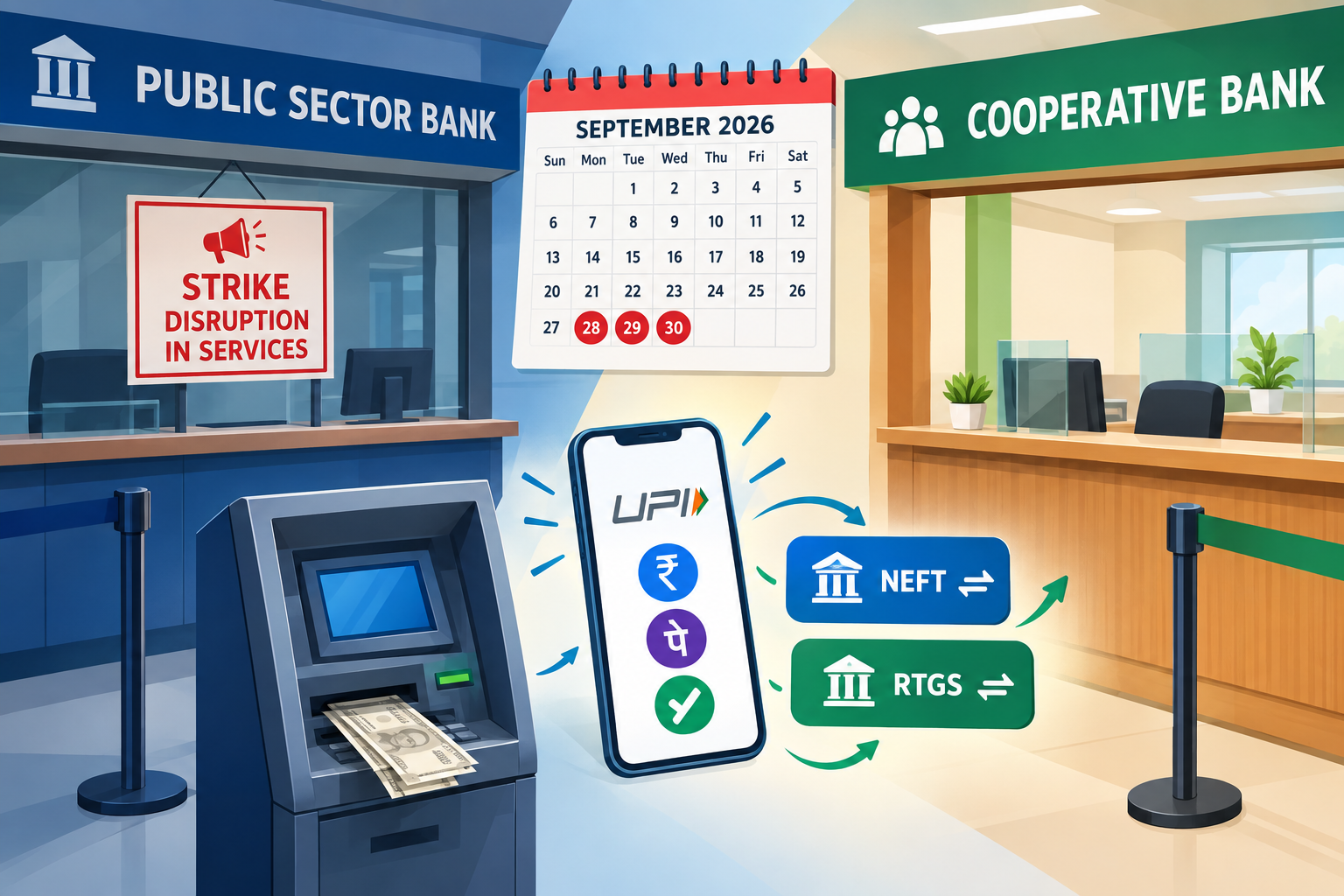
Bank customers across India are preparing for possible disruption from Monday, September 28, through Wednesday, September 30, 2026, following a three-day nationwide strike call by the United Forum of Bank Unions. The action is primarily connected to the unions’ demand for a five-day banking week.

The strike does not mean every bank or payment service will shut down. Its effect is expected to vary by institution, location and staff participation. Physical branches of public sector banks and regional rural banks are likely to face the greatest disruption, while digital channels should generally continue operating.
Cooperative banks are not joining the strike
Customers should distinguish the broader banking-union action from the position taken by the cooperative banking sector. The National Federation of Urban Cooperative Banks and Credit Societies, the National Urban Cooperative Finance and Development Corporation and the National Federation of State Cooperative Banks have said cooperative banks are not participating in the September 28-30 strike.
Cooperative-bank branches are therefore expected to open and provide services normally. However, customers with time-sensitive work should still confirm local branch hours, particularly because staffing conditions and regional holidays can differ.
Which bank branches may be affected?
The most visible impact is likely at public sector bank branches, where counter services could be reduced or unavailable depending on employee participation. Regional rural banks may also experience disruption. Some unionised employees at private banks could participate, but private-sector branch operations are generally expected to be less affected.
Customers may encounter delays involving cash deposits, cheque acceptance and clearing, demand drafts, passbook updates, account-opening formalities, KYC changes, loan documentation, locker access and other services that require staff approval or an in-person visit.
A strike does not automatically make every affected branch officially closed. Banks may attempt to keep selected locations functioning with available staff, but customers should not rely on completing urgent branch-dependent work during the three days.
Public sector banks and RRBs will open on Sunday
To provide an additional working day before the strike, public sector banks and regional rural banks are scheduled to operate on Sunday, September 27. The Reserve Bank of India has approved the operation of branches, offices, ATM-linked branches and currency chests that day.
Customers should use Sunday to finish urgent work where possible. It is advisable to confirm the opening hours of the specific branch before travelling, as local arrangements may vary.
What SBI’s ATM charge waiver means
State Bank of India has announced that ATM transaction charges will be waived for SBI customers from September 28 through September 30. During this period, SBI debit-card holders can use an ATM operated by SBI or another domestic bank without being charged for exceeding their usual number of free ATM transactions.
The waiver removes the transaction fee, but it cannot guarantee that every ATM will have cash. A prolonged reduction in branch and cash-management activity can affect replenishment at busy machines. Customers who need cash should withdraw a reasonable amount in advance rather than waiting until the final day or taking out more than necessary.
Will UPI, NEFT and RTGS work?
UPI, mobile banking, internet banking, card payments and IMPS are expected to remain available because these services operate electronically and are not limited to branch working hours. UPI payments normally function around the clock, including on bank holidays.
NEFT and RTGS are also designed to operate 24 hours a day throughout the year. Customers should therefore be able to initiate eligible transfers through their bank’s app or internet-banking portal during the strike.
Digital availability is not an absolute guarantee that every transaction will succeed immediately. Bank-specific technical problems, maintenance, network congestion or payment-system outages can still cause failures or delays. A transfer requiring manual branch verification may also take longer.
What customers should do before September 28
- Complete demand drafts, large cash deposits, cheque submissions, KYC updates, locker visits and documentation by September 27.
- Add new NEFT or RTGS beneficiaries early, because some banks impose an activation or cooling period.
- Check daily transfer limits and confirm that mobile banking, internet banking and UPI are working.
- Keep enough cash for essential expenses, but avoid panic withdrawals.
- Do not leave loan payments, tax payments, school fees or business obligations until the last day.
- Use digital transfers instead of cheques when the recipient accepts them.
- Check official messages from the bank for changes to branch hours or strike arrangements.
Because the action remains a proposed strike, negotiations or a last-minute decision could alter the schedule. Customers should prepare on the assumption that branch services may be disrupted while continuing to monitor updates directly from their bank.