Omar Abdullah’s J&K Statehood Motion Sparks Assembly Clash
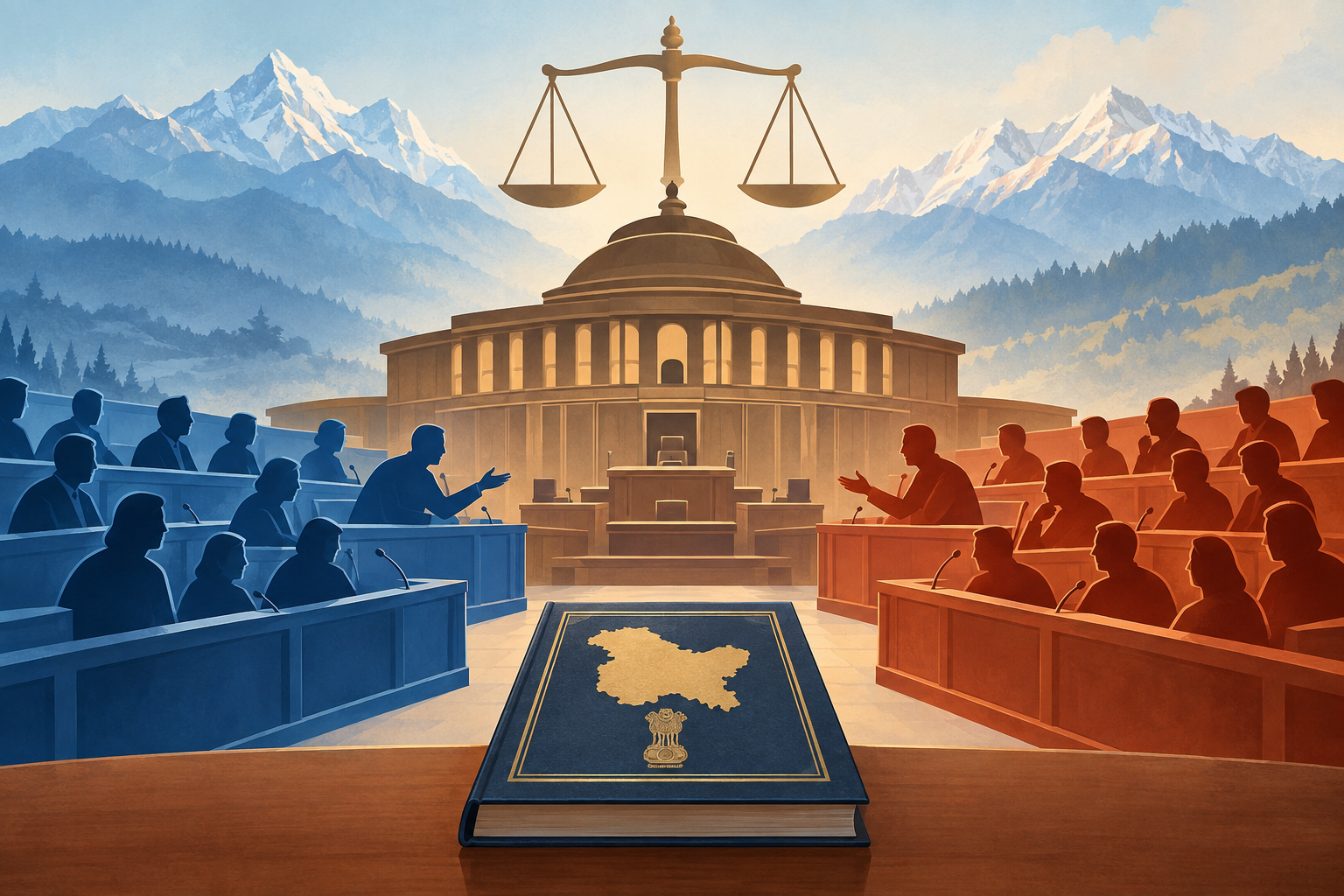
Jammu and Kashmir Chief Minister Omar Abdullah moved a resolution in the Legislative Assembly on September 25, 2026, calling on the Government of India to restore full statehood to the Union Territory immediately. The motion triggered an uproar after Bharatiya Janata Party legislators objected to its references to earlier resolutions concerning autonomy and special constitutional guarantees.

The resolution says that, in addition to measures adopted by the Assembly on June 26, 2000, and November 6, 2024, the House should call upon the Union government for the “immediate and urgent” restoration of full statehood. It also proposes forwarding the Assembly’s position to New Delhi.
Abdullah told the House that delimitation and Assembly elections had already taken place and argued that the remaining step in the sequence previously described by Union leaders was the restoration of statehood. He said Jammu and Kashmir had been promised full statehood rather than a more limited arrangement that would leave major state powers outside the elected government’s control.
Why the earlier resolutions became contentious
The June 2000 resolution was adopted when Farooq Abdullah’s National Conference government was in office. It sought a return to a substantially more autonomous constitutional arrangement associated with Jammu and Kashmir’s position before 1953. The Union Cabinet rejected that demand at the time.
The November 2024 resolution, passed after the first Assembly election held under the Union Territory framework, called for dialogue with elected representatives on restoring special status and constitutional guarantees. The BJP opposed that resolution, while several other parties supported it.
Omar Abdullah said the references were included because the new motion was focused specifically on statehood and was not intended to replace or cancel the Assembly’s earlier positions. According to the chief minister, omitting them could have been interpreted as the National Conference abandoning its wider political commitments on autonomy and special status.
Leader of the Opposition Sunil Sharma rejected that explanation. Sharma said the BJP supports the eventual restoration of statehood but considers the incorporation of the 2000 autonomy resolution and the 2024 special-status resolution unacceptable. He accused the National Conference of using a statehood motion to reopen questions that the BJP considers settled and asked the Congress to clarify whether it endorsed the earlier demands as well.
National Conference and Congress members welcomed the statehood demand, while members associated with the Peoples Democratic Party, Peoples Conference, Communist Party of India (Marxist) and Aam Aadmi Party also backed it. Peoples Conference leader Sajad Lone argued that statehood was a constitutional and political right rather than a concession from the Centre.
The protests brought proceedings to a halt, with BJP legislators entering the well of the House and tearing copies of the resolution. Speaker Abdul Rahim Rather ultimately adjourned the House. The motion had therefore been introduced and discussed, but had not completed a final vote before the adjournment.
How Jammu and Kashmir became a Union Territory
In August 2019, the Union government ended the special constitutional arrangements operating through Article 370 and Parliament enacted the Jammu and Kashmir Reorganisation Act. From October 31, 2019, the former state was divided into the Union Territory of Jammu and Kashmir, which has a legislature, and the Union Territory of Ladakh, which does not.
Under the present framework, Jammu and Kashmir’s Assembly can legislate on many subjects, but public order and police are excluded from its authority. Parliament retains broad legislative power over the territory, while the lieutenant governor has a substantially stronger constitutional position than a governor ordinarily has in a full-fledged state.
In December 2023, the Supreme Court upheld the constitutional changes concerning Article 370. The court recorded the Union government’s assurance that Jammu and Kashmir’s statehood would be restored and said restoration should occur at the earliest possible time, but it did not set a specific deadline. Assembly elections were subsequently held in 2024.
What the resolution can and cannot do
The Assembly motion can formally record the position of elected representatives, increase political pressure on the Union government and provide a basis for further debate. If adopted, it can be forwarded to New Delhi as an official request from the House.
It cannot, by itself, convert Jammu and Kashmir into a state, transfer control of police or public order, reduce the lieutenant governor’s powers or restore Article 370. A change in status requires legislation initiated at the Union level and approved by Parliament under the constitutional process governing the creation and reorganisation of states, followed by presidential assent.
Statehood and special status are also legally distinct questions. Restoring statehood would not automatically revive the pre-2019 constitutional arrangement or implement the 2000 autonomy demand. The powers and institutions created by any restoration measure would depend on the text of the law eventually passed by Parliament.