
What India’s 15,800 Additional Heat-Death Forecast Really Means
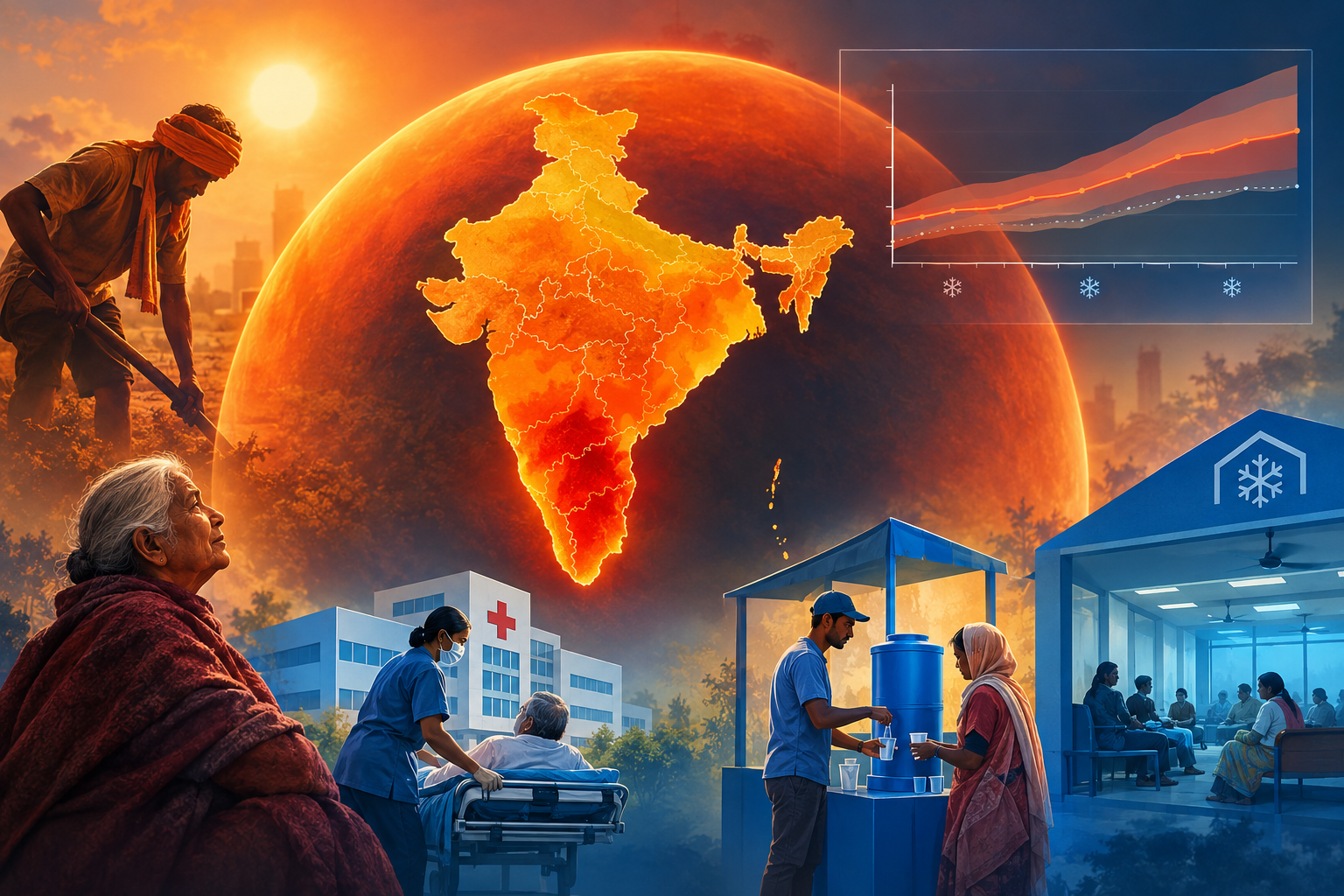
A new climate-health projection has placed India among the countries facing the greatest potential mortality burden from an exceptionally strong El Niño. The headline estimate—approximately 15,800 additional heat-related deaths—requires careful interpretation: it is a forecast for September 2026 through February 2027, not a count of deaths that have already occurred.

The assessment was produced by the Climate Impact Lab, a research collaboration linked to the University of Chicago. It estimates how many more deaths may occur because temperatures are forecast to be unusually high, compared with mortality expected under average conditions for the same months.
What the 15,800 figure measures
The central estimate compares the six-month forecast with the corresponding months in the 1996–2025 baseline period. In other words, the model asks how mortality could change if the anticipated temperature anomalies occur, relative to a recent 30-year climate normal.
It does not mean that 15,800 death certificates will identify heatstroke as the cause. Heat can also raise mortality indirectly by worsening cardiovascular, respiratory, kidney and other medical conditions. Excess-mortality models are designed to detect these broader changes in death rates, including cases in which temperature may never be recorded as the official cause.
The India estimate is reported as 15,800, plus or minus about 1,600. Because the stated range is calculated at roughly 1.96 standard errors around the mean, it corresponds approximately to an interval of 14,200 to 17,400 deaths under the model’s assumptions. That range should not be mistaken for a guarantee that the final outcome will fall within those limits.
How researchers produced the forecast
The calculation combines two main components. The first is a six-month seasonal temperature forecast from the ECMWF SEAS5 system, which uses a 51-member ensemble to represent different plausible weather outcomes. The second is an established model of how mortality changes as temperatures move away from locally familiar conditions.
The underlying mortality research drew on hundreds of millions of death records and detailed temperature observations. It estimated temperature-mortality relationships across 24,378 regions worldwide, accounting for factors including local climate, income, vulnerability and the capacity to adapt through cooling, infrastructure and health services.
Researchers then applied those relationships to the seasonal temperature anomalies expected from September 2026 through February 2027. The global forecast anticipates population-weighted land temperatures around 1.2 degrees Celsius above normal and approximately 44% more extremely hot days than in an average year.
Uncertainty from both the 51 weather simulations and the estimated relationship between temperature and mortality was carried into the final figures. However, the complete method for this specific seasonal application has not yet been published in a peer-reviewed journal. The underlying mortality framework has been peer reviewed, but the new short-term forecasting exercise remains an evolving assessment.
Where India’s exposure may be greatest
The national total does not imply equal risk across India. Southern areas are especially relevant during the winter portion of the forecast because their normal December-to-February temperatures are already warm enough to affect health. Additional warming can therefore push mortality higher even when northern India is experiencing comparatively cool conditions.
The researchers project about 7,400 of India’s additional deaths during December 2026 through February 2027. Northern India may show a smaller winter increase because its colder seasonal baseline can offset some heat-related mortality. That protection is temporary: the analysis expects risks in India and Pakistan to keep rising toward summer, beyond the current forecast window.
Exposure also depends on more than geography. Outdoor and manual workers, older adults, infants, pregnant people, those with chronic illnesses, residents of informal housing, people without reliable electricity or water, and communities with limited access to medical care face greater danger. Dense urban neighbourhoods can remain hot overnight because concrete and asphalt retain heat, reducing the body’s opportunity to recover.
Why the final toll could differ
Seasonal forecasts become less certain several months ahead, and El Niño does not affect every Indian region in the same way. Local rainfall, humidity, cloud cover, overnight temperatures and atmospheric circulation can alter actual exposure. Population movement, disease outbreaks, air pollution and electricity or water disruptions may also influence mortality in ways that are difficult to represent fully.
Human action is another major variable. Effective warnings, changed working hours, accessible drinking water, cooling spaces and rapid medical treatment could push mortality below the central estimate. Weak implementation, prolonged power failures or health-system strain could increase the burden.
Practical implications
The value of the forecast lies in providing months of lead time. Authorities can identify high-risk districts, ensure hospitals can recognise and treat heat illness, protect essential power and water services, and establish clear thresholds for changing outdoor work and school schedules.
- Issue local, multilingual heat alerts that explain what residents should do.
- Open cooling centres and hydration points in accessible public locations.
- Require shade, water, rest breaks and safer hours for outdoor workers.
- Conduct targeted outreach to older adults and medically vulnerable residents.
- Track excess mortality and hospital admissions, not only certified heatstroke deaths.
The projection is therefore best understood as a warning about preventable risk. Approximately 15,800 additional deaths is the model’s current central forecast under expected conditions—not an observed casualty figure and not an inevitable outcome.